Chemical processing plants represent some of the most demanding environments for spray nozzle technology. Handling hazardous materials across wide temperature and pressure ranges, operating under strict environmental and safety regulations, and running continuously for months at a time — these facilities depend on spray systems that perform reliably in corrosive, high-temperature, and particle-laden conditions. A nozzle failure in a gas scrubber or a quench tower is not a minor inconvenience: it can mean regulatory non-compliance, process upsets, or equipment damage. In this article, we examine the seven key spray nozzle applications across chemical processing operations and identify the BEX Engineering products best suited to each task.
Spray nozzles are integral to a wide range of chemical reactions and unit operations — not merely as support utilities but as active process components. Reactant addition, catalyst wetting, chemical dosing, neutralisation, and column irrigation all rely on nozzles to introduce liquids into a process stream or vessel in a precisely controlled manner. The requirements vary enormously: some applications demand fine atomisation for maximum surface area contact; others require a coarse, high-velocity spray to achieve the momentum needed to reach the centre of a large vessel.
Many chemical processes require a liquid reagent to be introduced into a gas stream, a liquid bath, or a vessel under controlled conditions. The rate, distribution, and droplet size of the spray directly affect reaction yield, selectivity, and safety. In absorption columns, for example, the scrubbing liquid must be distributed uniformly across the full column cross-section to ensure no gas bypasses the spray zone untreated. In neutralisation applications, the spray must deliver the correct stoichiometric quantity of reagent to the process stream with sufficient mixing to drive the reaction to completion.
Why it matters: spray distribution sets how much of the reagent actually reaches the reaction — gas that bypasses the spray zone leaves untreated, and uneven dosing costs yield and selectivity or leaves a neutralisation incomplete.
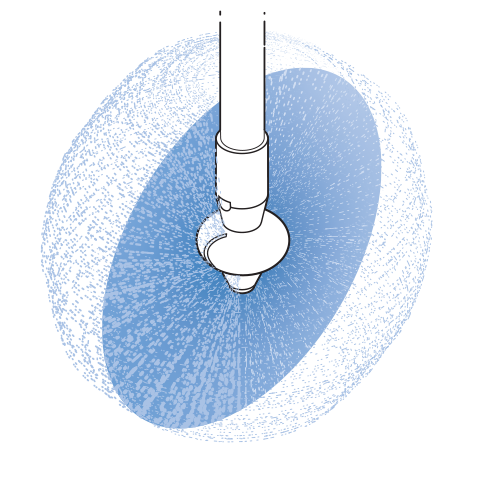
The BEX YS Series spiral (Twister) nozzles are the premier choice for chemical process spraying applications. Their one-piece, anti-clog design has no internal vanes or small passages that can block when handling particle-laden reagent solutions or slurries — the liquid flows through an open spiral channel, emerging as a full cone pattern. The YS Series is available in pipe sizes from 1/4" to 1-1/2" NPT and in spray angles from 60° to 170°, providing coverage flexibility for different column diameters and vessel geometries. For applications demanding extremely uniform distribution across a large cross-section, the S Series full cone nozzles provide a symmetrical, even spray pattern.
Packed absorption, stripping, and distillation columns depend on nozzles to distribute the liquid phase uniformly over the packing surface at the top of each bed. Inadequate liquid distribution is one of the most common causes of poor column performance, as maldistributed liquid creates dry zones in the packing where gas-liquid contact is absent. Distributor nozzles must produce a consistent spray pattern across the full column diameter and must resist fouling by the process liquid over extended operating campaigns.
Why it matters: maldistributed liquid leaves dry zones in the packing where no separation happens, so a column can be running at full energy cost while only part of its packing is doing any work.
The BEX YS Series spiral nozzles are widely used as distributor nozzles in packed columns because their open spiral design resists fouling by process liquids containing suspended solids, polymerised material, or crystallising salts. For clean service applications requiring maximum uniformity, the S Series full cone nozzles and SW Series wide-angle full cone nozzles provide the even, symmetrical coverage patterns that column designers specify for precise liquid-gas contacting. The PS and PSW series nozzles are also an option as they have larger flow rates and are often made of plastic for better corrosion resistance.
Foam formation is a persistent and costly challenge across the chemical process industries. In aeration basins, reactors, fermentation vessels, and separation equipment, foam is generated when surface-active substances — surfactants, proteins, polymers, or process by-products — stabilise gas bubbles at the liquid surface. If uncontrolled, foam can overflow containment structures, impair process instrumentation, reduce effective vessel volume, carry product or reagents out of the process, and create serious environmental and housekeeping problems. Two spray-based approaches are used in combination: mechanical knockdown using water or process liquid, and chemical defoamer application.
The simplest spray approach to foam control is mechanical impingement: water or recycled process liquid is sprayed directly onto the foam surface, physically collapsing the bubbles by impact. The use of spray nozzles located along the circumference of the aeration tank has proven effective for foam control. The spray must cover the entire foam surface uniformly — gaps in coverage allow foam to accumulate and overflow. For recirculated liquid systems, flow rates required range from 4–10 litres per minute per m² for light foams up to 50+ litres per minute per m² for heavy foams.
Why it matters: foam that finds a gap in the spray coverage builds up and overflows, carrying product or reagents out of the vessel and blinding the instruments that are supposed to be controlling the process.
In most foam-breaking applications the foam is stationary, and the aim is to cover the whole surface. BEX S Series full cone nozzles give that full coverage over an aeration tank or reactor. BEX F Series flat fan nozzles are also used, but their spray doesn't cover a whole stationary surface the way a full cone does. When the foam is moving, the BEX FL Series nozzles can create a wall of water that blocks and breaks the foam as it passes. Nozzles installed over aeration basins are continuously exposed to moisture, aerosols, and biological hydrogen sulfide, and should be specified in 316 stainless steel for corrosion resistance.
Where mechanical knockdown alone is insufficient, a chemical defoamer or antifoam agent is applied. The defoamer must be distributed evenly and at a precisely metered rate — too little and it is ineffective; too much wastes expensive chemistry and can contaminate the process. Fine atomization maximizes the effectiveness of the defoamer by distributing it as a fine mist across the foam surface, ensuring rapid and even dispersion of the active ingredient.
Why it matters: too little defoamer and the foam wins, too much and you've paid for chemistry that can end up contaminating the product — even, finely metered distribution is what keeps the dose where it needs to be.


The BEX JPL Series air atomizing nozzles are the ideal choice for chemical defoamer application, producing a very fine mist (10–50 μm droplets) that distributes defoamer uniformly across the foam surface while minimizing chemical consumption. The independent air and liquid controls allow the metered dose to be fine-tuned to match the severity of the foaming event. For lower-viscosity defoamer formulations where air atomization is not required, the C Series hollow cone nozzles in small orifice sizes deliver a fine, wide-angle spray that covers the foam surface efficiently at low flow rates.
Hot gas conditioning is a critical upstream step in virtually every chemical plant emission control and gas treatment system. High-temperature process gases and flue gases must be cooled before they reach downstream equipment such as baghouses, electrostatic precipitators, wet scrubbers, or further processing units that cannot tolerate high temperatures. A quench tower or hot gas quench system is often the first step in conditioning a high-temperature and polluted air stream so that particulate, acid gases, metals, and other emissions can be appropriately removed. The cooling mechanism is evaporative: water is atomized into the hot gas stream and absorbs heat as it evaporates, reducing gas temperature while also reducing gas volume — which reduces the size and cost of downstream equipment.
Nozzle selection is the most critical design decision in a quench tower. The droplets must be small enough to evaporate fully before reaching the vessel wall — wall wetting causes corrosion and solids deposition that can block the vessel and cause serious operational problems. At the same time, the droplets must not be so fine that they are carried through the vessel without fully evaporating, resulting in wet gas downstream. Uniform distribution of the spray across the full vessel cross-section is equally important: hot spots in the gas stream where coverage is poor result in incomplete cooling and can damage downstream equipment.
Why it matters: droplets that reach the vessel wall cause corrosion and solids buildup, while droplets that don't evaporate send wet gas downstream — and any hot spot left by poor coverage goes straight on to equipment that can't tolerate it.
The BEX YS Series spiral (Twister) nozzles are the standard choice for quench tower and gas cooling applications, listed by BEX as a typical application for this series. Their open spiral design produces a full cone spray pattern with a range of droplet sizes suited to evaporative cooling — enough fine droplets for rapid heat transfer and enough larger droplets to ensure complete evaporation before reaching the vessel wall. Critically, the YS Series has no internal vanes or precision orifices to clog when handling the recycled, often contaminated process water used in industrial cooling systems. For applications requiring finer atomization to reduce the risk of wall wetting in shorter towers, the H Series hollow cone nozzles produce a finer droplet spectrum. All quench tower nozzles should be specified in 316 stainless steel or Hastelloy C-276 for resistance to the hot, acidic gas environments typically encountered. The YH hollow cone series nozzle can also be used.
Gas washing — also called wet scrubbing — is one of the most important spray nozzle applications in the chemical process industries. Chemical plants generate process gases and flue gases containing acid gases (HCl, SO₂, H₂S), volatile organic compounds (VOCs), chlorine, ammonia, and fine particulates. Wet scrubbers remove these contaminants by spraying a liquid into the gas stream, where the liquid droplets contact the gas and absorb or react with the target pollutants. The effectiveness of the scrubbing process depends on several interrelated factors: the total liquid surface area presented to the gas (more smaller droplets means more surface area), the contact time between liquid and gas, and the uniformity of spray coverage across the gas flow cross-section.
In packed tower scrubbers, nozzles spray liquid onto the top of the packing material, which trickles down through the packing as gas flows upward in countercurrent contact. In open spray towers, nozzles must create a dense curtain of droplets across the entire tower cross-section to ensure no gas bypasses the spray zone. In duct-mounted and venturi scrubbers, nozzles inject spray into the gas duct where high-velocity flow creates turbulent contact between liquid and gas.
Why it matters: any gas that slips past the spray curtain leaves the stack untreated, and in a recirculated scrubber a nozzle that starts to clog quietly opens up exactly that kind of gap.
The BEX YS Series spiral (Twister) nozzles are the premier choice for gas washing applications in chemical plants. Their open spiral design resists clogging even when the scrubbing liquid contains dissolved solids or suspended particles — a common condition in recirculated scrubber systems where reagent slurries and reaction products accumulate over time. The spiral design produces a range of droplet sizes well suited to gas washing: fine droplets for efficient gas-liquid contact and larger droplets that penetrate deep into the gas stream. For applications requiring extremely uniform coverage in packed tower distributors, the S Series full cone nozzles provide a symmetrical, even spray pattern.
Environmental regulations governing chemical plant emissions are among the most stringent in any industry. The Clean Air Act and its National Emission Standards for Hazardous Air Pollutants (NESHAP) impose strict limits on emissions of acid gases, organic compounds, particulate matter, and metals. Compliance is not a discretionary objective — it is a legal obligation enforced through continuous emissions monitoring, with significant penalties for exceedances. Spray systems are at the heart of most emissions control technologies used in the chemical industry.
Sulphur dioxide (SO₂), hydrogen chloride (HCl), and hydrogen fluoride (HF) from combustion and chemical processes must be removed before gases are vented to atmosphere. In spray tower FGD systems, a reagent slurry is introduced as atomised droplets through spray nozzles at the top of, or in stages within, the scrubber. The SO₂-laden gas enters at the bottom and travels upward in countercurrent flow, reacting with the alkaline slurry (typically limestone or lime) to form calcium sulphate. Nozzle selection directly affects SO₂ removal efficiency: the primary indicators of wet scrubber performance include liquid flow rate and gas-liquid contact uniformity, both of which are direct functions of nozzle performance.
Why it matters: SO₂ removal efficiency is set by liquid flow and contact uniformity, so a nozzle that erodes or plugs in abrasive slurry service shows up directly as higher emissions and a compliance problem.
The BEX YS Series spiral nozzles handle the limestone and lime slurries used in FGD systems without clogging — a critical advantage over conventional full cone nozzles, whose small internal orifices and vanes rapidly erode and foul in abrasive slurry service. For mist eliminator wash-down upstream of the FGD tower outlet, the F Series flat fan nozzles arranged to spray across the face of the mist eliminator pads prevent solids buildup that would increase pressure drop and reduce gas throughput. All nozzles for FGD service should be specified in corrosion-resistant alloys: 316 stainless steel for lime service, and Hastelloy C-276 or PVDF for HCl or HF service. The FP series flat fan nozzles are also an option if higher impact is required.
Chemical plants processing volatile organic compounds, amines, mercaptans, and other odorous materials use spray systems to absorb these compounds from ventilation air before it is discharged. Caustic soda solution scrubbers neutralise acid gases and destroy odorous compounds; oxidising solution scrubbers use sodium hypochlorite or hydrogen peroxide to chemically degrade VOCs and odour compounds. The nozzle must produce sufficient liquid surface area and coverage uniformity to achieve the required removal efficiency within the available vessel height.
Why it matters: removal has to happen within a fixed vessel height or duct length, so if the spray doesn't present enough liquid surface to the whole gas stream, the untreated fraction goes straight out to the neighbours.
For odour control and VOC scrubbing towers, the BEX YS Series spiral nozzles and S Series full cone nozzles provide the uniform, thorough coverage needed to ensure all of the gas stream contacts the scrubbing liquid. For duct injection of neutralising chemicals into ventilation air streams, the H Series hollow cone nozzles produce fine droplets that maximise gas-liquid contact area in the short contact time available in duct injection applications. YH series hollow cone nozzles are also an option.
Chemical processing generates sludges and slurries in settling tanks, clarifiers, neutralisation sumps, and waste treatment basins. These high-solids liquids will settle and consolidate into hard deposits if not continuously agitated. Settled sludge is extremely difficult and costly to remove, can block tank outlets and drains, and can reduce effective tank volume to a fraction of design capacity. Conventional mechanical agitators — paddle mixers, turbine impellers — are effective but introduce rotating equipment that requires seals, bearings, and gearboxes; these components fail in corrosive and abrasive environments and represent a significant ongoing maintenance burden.
Eductor-based mixing systems provide a compelling alternative for sludge and slurry tanks. Eductors use the Venturi principle: pressurised liquid is pumped through the eductor, creating a low-pressure zone that draws in surrounding tank liquid and discharges a combined flow that is four to five times the volume of the pumped liquid. This creates continuous circulation throughout the tank with no moving parts inside the tank itself, eliminating the seals and bearings that fail in corrosive service. Eductors may be employed effectively in tanks used for sludge, slurries, and chemical mixing applications, and they reduce settling of suspended solids while maintaining uniform liquid characteristics throughout the tank.
Why it matters: settled sludge consolidates into hard deposits that block outlets and eat into tank volume, and removing it later is far more costly than keeping solids in suspension from the start.
BEX eductors are available in moulded plastic (TMMP Series mini eductors and T-MP Series regular-size plastic eductors for corrosive chemical service in PVDF or polypropylene) and in stainless steel (T-M Series stainless steel eductors) for high-temperature or mechanically demanding applications. For sludge tanks, the stainless steel models are typically selected for mechanical robustness against abrasive solids. Eductors should be positioned as close as possible to the tank bottom — typically within 12” (300 mm) of the floor — and spaced at approximately 12” (300 mm) intervals for uniform agitation. The BEX Tank Mixing Eductor Purchase Guide provides detailed guidance on eductor sizing, placement, and pump sizing for specific tank geometries and solids loadings.
Chemical process tanks, reactors, storage vessels, and intermediate containers must be cleaned between product campaigns, before maintenance entry, and on a scheduled basis to prevent contamination, remove product residues, and maintain the vessel in a fit-for-purpose condition. Manual confined space entry for cleaning is increasingly prohibited under safety regulations — it is hazardous, time-consuming, and costly. Automated tank cleaning nozzles inserted through existing manways or top connections can clean the entire interior of a vessel without any personnel entry, dramatically improving both safety and cleaning efficiency.
The engineering challenge in tank cleaning is ensuring that every interior surface of the vessel receives sufficient mechanical impingement and chemical contact from the cleaning solution to remove the residue present. Static spray balls cover the tank walls with a low-velocity flow — adequate for light residues and rinse applications, but insufficient for removing viscous, polymerised, or crystallised chemical deposits. Rotating tank washing nozzles provide a more energetic solution: their rotating solid-stream jets deliver higher impingement force at the target surface while consuming less cleaning solution than static devices.
Why it matters: residue left in a vessel contaminates the next product campaign, and every tank that can be cleaned from outside is one less confined-space entry putting a person at risk.
The BEX TWK Series rotating tank washing nozzles are purpose-built for this application. Available in machined 316 stainless steel and all-PTFE (Teflon) construction — with both NPT threaded and tri-clamp sanitary connections — they provide 360°, 270°, and 180° coverage patterns to reach every interior surface of the vessel, including areas obstructed by internal coils, agitator shafts, baffles, and other internals. The all-PTFE models are particularly important in chemical service where metallic contamination of the product, or attack on the nozzle by the process chemistry, is a concern. For smaller vessels and headers, the SN4922 Clean-in-Place nozzle disperses multiple solid-stream sprays in a 252° radius from a compact, single-piece 316SS body, providing high-impingement cleaning without the complexity of a rotating assembly.
Chemical processing presents the most demanding material compatibility challenges of any industry. Process fluids range from strong mineral acids and caustic solutions to halogenated solvents and oxidising reagents, and a single plant may handle dozens of chemically incompatible materials in different areas. Nozzle material selection must be matched to each specific process chemistry, temperature, and concentration:
| Material | Best for |
|---|---|
| 316 Stainless Steel | The standard for most aqueous industrial applications, including mild acid service, caustic scrubbers, cooling water systems, and clean utility services. The baseline material for all BEX threaded nozzles unless the process chemistry requires otherwise. |
| Hastelloy C-276 | Required for severe chemical service involving hydrochloric acid, sulfuric acid at elevated temperatures, chloride-containing solutions, and mixed acid environments encountered in many chemical processes. Significantly higher corrosion resistance than 316SS at elevated temperatures and concentrations. |
| PVDF (Polyvinylidene Fluoride) | Excellent chemical resistance to most acids, bases, halogens, and organic solvents. Suitable for temperatures up to approximately 120°C. The polymer of choice for FGD systems handling HF-contaminated scrubbing liquids, and for anhydrous HCl service. Don’t use PVDF with caustic (NaOH). |
| PTFE (Teflon) | Required for the all-PTFE TWK Series tank washing nozzles in applications where absolute chemical inertness and freedom from metallic contamination are mandated. Suitable for virtually all process chemicals except molten alkali metals and fluorine. |
| Polypropylene | Cost-effective for moderate-temperature acid and base applications; common in anodising and surface treatment lines. Standard material for the TMMP and T-MP Series plastic eductors. |
Spray nozzles are not peripheral to chemical processing — they are integral to the core operations that define plant safety, environmental compliance, product quality, and operational efficiency. From the gas washing towers that keep emissions within regulatory limits, to the quench systems that protect downstream equipment from thermal damage, to the sludge tank eductors that prevent settled solids from impairing waste treatment, to the tank cleaning nozzles that eliminate confined space entry — every application places specific and demanding requirements on the nozzle selected.
BEX Engineering provides the full spectrum of spray nozzle solutions for the chemical process industries, with materials and configurations to handle virtually any chemical environment. Contact BEX Engineering to discuss your chemical processing spray nozzle requirements.