The automotive industry represents one of the most demanding and precision-critical sectors for industrial spray nozzle technology. From the moment a vehicle's body shell arrives at the manufacturing line to the point where it leaves a truck wash facility, spray nozzles play an integral role in ensuring quality, efficiency, and environmental compliance. Whether in original equipment manufacturer (OEM) production facilities or in the highly specialized world of auto maintenance and truck washing equipment, the right nozzle selection can mean the difference between a spotless finish and a compromised product.
At BEX Engineering, we understand the unique challenges that automotive manufacturers and vehicle maintenance equipment OEMs face. The applications are diverse, demanding, and often involve harsh chemicals, and the need for precise liquid distribution. This blog post explores how our spray nozzle solutions address the critical requirements of both automobile manufacturers and auto & truck maintenance equipment OEMs.
The automotive industry relies on spray nozzles for two primary contexts: integrated manufacturing processes within automobile plants and specialized equipment sold to fleet maintenance operations and commercial car wash facilities. Both contexts require different approaches, yet share common principles of precision, reliability, and durability.
In automotive manufacturing plants, spray nozzles handle everything from initial body preparation through final quality checks. These applications demand nozzles that can withstand corrosive phosphating solutions, maintain precise spray patterns over thousands of operating hours, and deliver consistent results without clogging or wear. Meanwhile, OEMs producing truck washing systems and maintenance equipment need nozzles that are easy to specify, cost-effective in volume, and available in configurations that allow equipment manufacturers to offer versatile solutions to their customers.
The stakes in both contexts are high. In manufacturing, inconsistent spray patterns can result in incomplete coating coverage, requiring rework or scrapping of vehicle components. In fleet maintenance, inadequate cleaning or uneven rinse patterns can leave residue that compromises appearance or function, leading to customer complaints and repeat service calls. This is why selecting the right nozzle is not a peripheral decision but rather a core engineering consideration.
The initial preparation of vehicle bodies involves removing oils, dirt, and contaminants before the application of coatings and paint. This multi-stage process begins with an alkaline wash, followed by a water rinse to remove the cleaning solution. The spray nozzles used in these stages must deliver a uniform, forceful spray pattern that covers every surface of the vehicle body without creating dead zones or excessive turbulence.
Why it matters: a dead zone or excess turbulence in this stage leaves contaminants on the body shell that coatings then seal in — a defect caught after paint means reworking or scrapping the panel, not just re-spraying it.
The F Series flat fan nozzles are the industry standard for these applications. Precision machined from durable materials and available in angles from 0 to 110 degrees, the F Series provides the flat, coherent spray pattern required for uniform coverage across large surfaces. The ability to select from multiple spray angles allows manufacturers to optimize coverage in tight spaces and around complex geometry. Whether mounted in a single header or in a multi-nozzle array, these nozzles deliver the consistent flow rates and spray angles that make industrial-scale vehicle washing reliable and repeatable.
For applications where the alkaline wash solution presents a risk of nozzle clogging due to mineral content or additive precipitation, the FP Series or FL Series flat fan nozzles offer superior clog resistance. The FP Series delivers high-impact spray for applications where stubborn deposits require additional mechanical force, while the FL Series provides a focused, narrow curtain suited to targeted wash zones. Both designs reduce the likelihood of particle accumulation and blockages that can compromise wash quality. In high-volume manufacturing environments where downtime is extraordinarily costly, this inherent reliability proves invaluable. Where cost considerations require an alternative to precision-machined brass nozzles, the FT Series injection molded flat fan nozzles deliver excellent performance at a fraction of the price. These economical plastic alternatives maintain the flat fan spray pattern and are suitable for many washing and rinsing stages, particularly where the chemicals involved do not require the exceptional chemical resistance of machined materials. For many OEMs designing equipment packages, the FT Series offers the performance-to-cost ratio that makes their products competitive without sacrificing core functionality.
Beyond standard washing and phosphating, automobile manufacturers employ specialized testing and finishing processes that require precise spray distribution. Rain testing simulates natural water conditions to verify that vehicle assembly seals, gaskets, and drainage systems function correctly. This application demands full cone spray patterns that distribute water uniformly across the entire test chamber while maintaining low pressure to mimic actual rainfall.
Why it matters: rain testing only proves what it actually sprays — flood the chamber uniformly instead of targeting the seams and seals being evaluated, and a real leak path can go untested.
For rain testing, manufacturers use F Series flat fan nozzles targeted precisely at the natural leak points of the vehicle — window seals, door seams, body panel joints, and other areas where water ingress is most likely. Rather than flooding the entire test chamber uniformly, this targeted approach directs a focused water curtain at the specific sealing points being evaluated, providing a more efficient and revealing test. The flat fan pattern allows nozzles to be angled and positioned so each potential leak site receives direct, repeatable water impingement. For the final rinse stage, particularly where water quality or appearance is critical, some manufacturers employ ionized water rinse systems. This sophisticated finishing process requires fine mist application to minimize water spots and streaking on painted surfaces. The H Series hollow cone nozzles produce a fine droplet spray from a hollow conical pattern, ideal for applications where surface finish quality is paramount. The hollow cone design concentrates droplets around the perimeter of the spray pattern while maintaining a clear center, allowing for precise positioning in confined spaces while delivering the fine droplet characteristics necessary for spotless rinsing.
Heavy-duty components such as engine blocks, transmissions, and chassis parts require vigorous washing and degreasing before assembly. These applications often involve heated alkaline solutions with degreasers that demand both mechanical force and chemical action. The challenge lies in achieving sufficient impact energy to remove stubborn deposits while maintaining nozzle integrity against harsh solvents.
Why it matters: these solutions are heated and caustic precisely because the deposits are stubborn, so a nozzle that degrades under that chemical load fails exactly when the cleaning job gets hardest.
The F Series flat fan nozzles again prove ideal for parts washing applications. Their precision machining and available material options, including stainless steel and specialized alloys, provide the durability needed for extended service in degreasing environments. The flat fan spray pattern delivers concentrated impact along a linear path, ideal for directing cleaning force onto specific surface areas. Where applications demand greater impingement force to dislodge stubborn deposits such as core sand from cast engine blocks or hardened machining residue, the FP Series high-impact flat fan nozzles are the preferred choice — a sloped ramp ahead of the (round) orifice concentrates the spray into a thinner footprint, delivering significantly higher impact energy at the target surface for the same supply pressure. When parts washing involves recirculation systems where solution is filtered and reused, the FP Series and FL Series flat fan nozzles become particularly valuable. Recirculated degreaser solutions often contain suspended particles and additives that can accumulate in conventional nozzle orifices. The FP Series delivers the high-impact pattern needed for aggressive cleaning, while the FL Series provides a focused curtain for targeted wash zones — both designs resist clogging tendencies that plague conventional nozzles in these applications, ensuring consistent spray performance throughout extended operating cycles.
Environmental regulations increasingly require sophisticated pollution control systems within automotive manufacturing facilities. Spray nozzles play a critical role in water treatment and emission control systems. For example, quenching towers and scrubber systems require nozzles that can atomize water to maximize surface area for heat and mass transfer while withstanding the corrosive and abrasive environment created by dust, fumes, and recycled water.
Why it matters: a scrubber's entire function depends on contact between spray and contaminant — droplets sized wrong for the application pass straight through the gas stream instead of capturing what they're meant to capture.
The JPL Series air atomizing nozzles represent the cutting edge of spray atomization technology. These ultra-fine mist nozzles combine pressurized liquid with compressed air to create exceptionally fine droplet distributions. In quenching and scrubber applications, this fine mist dramatically increases the effective contact surface area between the atomized liquid and airborne particles or contaminants. The JPL Series excels in applications where maximum coverage and mass transfer are essential, and where traditional liquid-only spray patterns would be insufficient.
Motor block cleaning prior to final assembly represents another critical application within manufacturing plants. These cast iron and aluminum components require removal of core sand, machining oils, and other manufacturing residue. The process demands both mechanical force and chemical action, often employing heated alkaline solutions.
Why it matters: core sand and machining residue left behind on a cast block becomes a contamination source once the engine is assembled — the wash has to reach every internal passage, not just the visible exterior surfaces.
The S Series full cone nozzles deliver uniform, spray distribution suitable for tumble washing or immersion cleaning where the components are subjected to rotating spray coverage from multiple directions. The uniform distribution characteristic of the S Series ensures that no area receives excessive impact that could cause component damage while ensuring complete coverage.
Original equipment manufacturers producing car wash equipment for commercial facilities and fleet operations face a unique challenge: they must design systems that are flexible, reliable, and capable of producing consistently excellent results across different vehicle sizes and conditions. The nozzle selections embedded in their equipment designs directly impact their reputation and customer satisfaction.
Detergent application in car wash systems requires uniform distribution of cleaning solution across the vehicle surface while using minimal water to minimize runoff and environmental impact (see: the science behind carwash soaps).
Why it matters: too much water and detergent becomes runoff with an environmental cost; too little and coverage gaps mean the rinse and wheel stages downstream are cleaning up a wash step that didn't finish its job.
The F Series flat fan nozzles are the preferred choice for this stage, offering precise spray angle control that allows equipment designers to create pre-rinse and soap application stages with minimal solution waste. By selecting the appropriate spray angle, the F Series delivers sufficient volume and coverage while maintaining the spray coherence that prevents solution from splashing back or missing critical surface areas.
The rinse stage in professional car wash systems demands even more precision. Incomplete rinse results in streaking and spotting, leading to customer dissatisfaction and repeat business loss.
Why it matters: any detergent left behind by an incomplete rinse shows up later as streaking or spotting on the vehicle — a customer-visible defect that traces directly back to this one step.
The F Series and FL Series flat fan nozzles prove ideal for the rinse stage — their focused spray pattern efficiently sweeps detergent from the vehicle surface. The FL Series is particularly useful where a narrower, more directed curtain is needed to rinse door seams and panel joints thoroughly.
Why it matters: wheel wash nozzles are mounted low and aimed inward specifically to reach packed mud and road salt without hitting tire sidewalls or wheel finishes — misdirect that force even slightly and the equipment starts damaging the vehicles it's meant to clean.
For wheel cleaning, where concentrated spray force is needed to remove brake dust and road grime from wheel surfaces and inside fender areas, the F Series flat fan nozzles available in a wide range of angles allow equipment designers to concentrate spray force where mechanical action is most needed. The wheel wash subsystem represents a particularly challenging application. Mounted low and directed inward from multiple angles, wheel wash nozzles must deliver sufficient force to remove packed mud and road salt while avoiding damage to tire sidewalls or wheel finishes. The F Series nozzles, with their concentrated impact along a linear path, prove superior to full cone alternatives for this task. Equipment manufacturers can select specific angles and flow rates to tune the aggressive washing action to the target customer segment, whether light-duty car wash operations or heavy-duty truck washing facilities.
Why it matters: uneven bead lubrication doesn't just risk a poor seal at mounting — a lubricant formulation prone to settling or separation can leave some beads under-wetted and others over-wetted from the very same spray cycle.
For premium car wash systems employing tire bead lubrication prior to mounting—a specialized application that protects tire beads and rim interfaces—the FP Series or FL Series flat fan nozzles offer excellent precision and clog resistance. This application often involves specialized lubricant formulations that may be prone to settling or separation; the FP Series provides firm, even coverage where complete bead wetting is the priority, while the FL Series suits installations where a wide, spray curtain is needed.
Heavy-duty commercial vehicle washing represents one of the most demanding spray nozzle environments. Buses and trucks accumulate substantial loads of road dirt, salt, algae, and insect residue that require aggressive washing to remove completely. Equipment manufacturers designing solutions for truck stops, municipal fleet facilities, and commercial car washes must specify nozzles capable of withstanding high-pressure operation, harsh environments, and intense use cycles.
Why it matters: winter road salt is what makes this environment so corrosive, so a material choice that's fine for a passenger car wash can fail fast here — and a spray pattern that's too concentrated risks denting or scratching the vehicle it's supposed to clean.
The F Series flat fan nozzles again emerge as the primary choice, but in heavy-duty truck washing applications, material selection becomes critical. Stainless steel construction provides superior durability in the salt-laden, chemically aggressive environment typical of winter road conditions where salt is applied to highways. Equipment manufacturers commonly specify wide-angle F Series nozzles (75-110 degrees) mounted in arrays to deliver overlapping coverage that removes accumulated debris without creating high-pressure zones that could cause paint damage or dent vehicle bodies.
Why it matters: recycled water carries the sediment it picked up on its last pass through the system, so a nozzle that isn't built to resist that buildup clogs faster the longer the wash system has been running — the opposite of what a maintenance-interval improvement should do.
For wash systems handling recycled water where sediment accumulation is a persistent maintenance problem, the FP Series and narrow-angle F Series flat fan nozzles significantly reduce clogging incidents. The FP Series is suited where high-impact spray is needed to cut through road grime on large vehicle surfaces, while a narrow-angle F Series nozzle delivers a precise, concentrated curtain for targeted wash zones such as wheel arches and undercarriage channels. Both designs allow equipment operators to extend maintenance intervals and reduce unplanned downtime for cleaning and nozzle replacement.
Why it matters: a mobile or remote truck wash unit doesn't have a technician on-site the moment a nozzle clogs, so for those operations, resistance to fouling isn't a convenience — it's what keeps the unit running at all.
The YS Series spiral/Twister nozzles represent a specialized choice for certain truck washing scenarios. These clog-resistant nozzles employ a helical deflection surface that continuously sweeps the orifice, actively preventing particle accumulation even in heavily contaminated water. For mobile truck wash units operating in remote locations where filter maintenance is impractical, or for high-volume operations where any downtime is costly, the YS Series provides insurance against clogging that competing designs cannot match.
Why it matters: tire mounting is often done by technicians with minimal specialized training, so the nozzle has to deliver a predictable, repeatable result on its own — it can't rely on operator skill to compensate for an uneven spray.
The FP Series and narrow-angle F Series flat fan nozzles are well suited for this application, providing uniform spray patterns at low pressures that prevent over-application while ensuring complete coverage. A narrow-angle F Series nozzle is the right choice where the lubricant must be directed as a precise curtain onto the bead seat, while the FP Series suits applications where slightly greater impingement helps spread viscous lubricant evenly. Equipment designers value the consistency and reliability of both series in tire mounting systems where user training is minimal and predictable results are essential.
Large-scale automotive manufacturing facilities and mobile truck wash operations require periodic cleaning of chemical storage and solution tanks.
Why it matters: residue left behind in a solution tank doesn't stay put — it contaminates the next batch mixed there or becomes a site for bacterial growth in long-term storage, so incomplete interior coverage is a carryover problem, not a one-time miss.
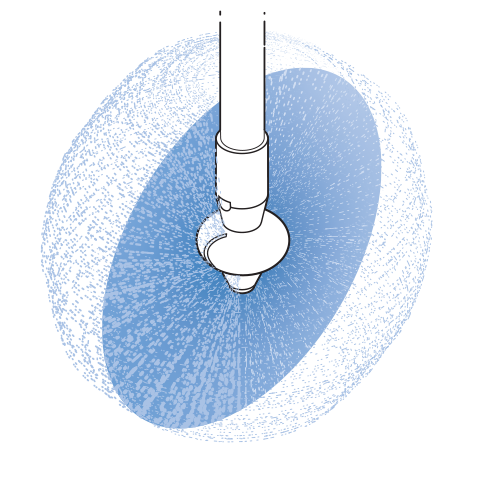
The TWK Series tank washing nozzles are specially designed for this critical maintenance function systematically covering tank interior surfaces while directing soil and contaminants toward drain points. These nozzles prevent the accumulation of residue that could contaminate fresh solution batches or create bacterial growth in long-term storage applications.
Many automotive washing and degreasing operations employ solution tanks where chemical agents require mixing and agitation to maintain consistent concentration and effectiveness.
Why it matters: a solution that isn't kept uniformly mixed drifts in concentration across the tank, so a batch drawn from one point can perform differently than one drawn from another — consistency here depends entirely on agitation, since there are no moving parts to fall back on.
BEX eductors, particularly the T-series designs, provide engineered mixing solutions that operate without moving parts. By directing pressurized nozzle discharge through specially designed diffusor, BEX eductors create powerful circulation and agitation within the tank. This approach reduces operational complexity while ensuring that solution properties remain uniform throughout extended operating periods.
Why it matters: every minute spent swapping nozzle configurations with tools is downtime a production line or fleet facility is paying for — the value of a tool-free changeover is measured directly in the changeover time it removes.
In automotive manufacturing plants and fleet maintenance facilities where flexibility and rapid equipment changeover are required, the K-Ball ZF quick-change assemblies provide engineered solutions for nozzle installation and replacement. These modular systems allow technicians to swap nozzle configurations without tools, reducing downtime during process adjustments or nozzle maintenance. For equipment manufacturers designing systems intended for multiple customer segments or applications, K-Ball ZF quick-change capability enables customers to reconfigure their equipment without replacing entire spray headers.
The selection of nozzle materials represents another critical dimension of automotive spray system design. BEX’s 316 stainless steel F Series nozzles provide excellent chemical resistance and durability for most automotive applications, while stainless steel alternatives suit particularly aggressive environments. The injection-molded plastic F, FT, FL, Series offer cost advantages where chemical exposure is limited or application intensity is moderate.
Modern automotive manufacturing increasingly emphasizes environmental stewardship and waste reduction. Spray nozzle selection contributes to these goals by ensuring efficient chemical utilization and minimal runoff. Precisely patterned spray from F Series and H Series nozzles minimizes waste by delivering solution exactly where needed rather than creating excess spray that becomes runoff. Fine atomization from SA Series air atomizing nozzles maximizes mass transfer in pollution control applications, reducing the overall volume of water required for effective treatment.
The automotive industry's reliance on spray nozzle technology extends far beyond simple fluid delivery. From the moment vehicle bodies enter manufacturing plants through their eventual maintenance in commercial fleet facilities, the right nozzle selection impacts manufacturing efficiency, product quality, environmental compliance, and operational cost. BEX Engineering's comprehensive product portfolio addresses every stage of this journey.
Whether you are an automobile manufacturer designing process improvements, an OEM developing the next generation of commercial vehicle wash equipment, or a fleet operator maintaining your mobile truck wash system, our experienced engineering team can help specify the optimal nozzle solution. Our precision-machined F Series flat fan nozzles, FV Series , economical FT Series plastic options, full cone S Series, fine mist H Series, ultra-fine JPL Series air atomizing nozzles, and specialized YS Series spiral nozzles represent decades of industrial spray engineering refined to address the automotive industry's most demanding applications.
For detailed technical specifications, application guidance, or custom nozzle solutions for your specific requirements, contact BEX Engineering today. Our team stands ready to help you optimize spray performance, reduce operational costs, and ensure consistent results across your automotive manufacturing or maintenance operations.
Contact BEX Engineering Let our spray nozzle specialists help you achieve precision and performance in your automotive applications. Reach out today for a consultation.