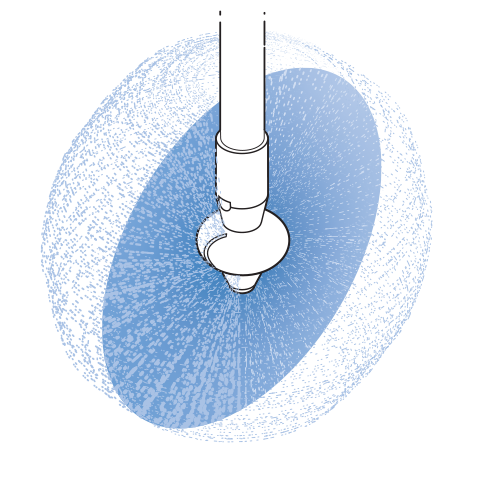
Pulp and paper mills and textile mills share a deep reliance on water — and by extension, on spray nozzle technology. Both industries process fibrous materials through sequences of wet and dry stages, both require precise moisture control for product quality, both must manage chemical application and recovery, and both face significant environmental compliance obligations. In this article, we examine the critical spray nozzle applications common to these fiber-processing industries and identify the BEX Engineering products best suited to each.
A modern pulp and paper mill is one of the most water-intensive industrial operations in existence. Water is used as a process medium (carrying wood fibers through the system as slurry), as a cleaning agent, as a chemical carrier, and as a cooling and fire protection medium. Spray nozzles appear throughout the mill — from the log yard to the finishing rolls.
Rotary screens (also called cylinder molds or drum washers) are used throughout the pulp mill to separate pulp fibers from process liquors — during brown stock washing (removing spent cooking chemicals from freshly pulped fibers), in bleaching stages (removing spent bleach chemicals), and in cleaning and screening operations. Spray nozzles positioned along the screen surface apply wash water that displaces the process liquor from within the fiber mat as it forms on the rotating screen.
Effective screen washing depends on uniform spray distribution across the full width of the screen. Any gaps or weak spots in the spray coverage result in inadequate washing in those areas, carrying over unwanted chemicals that reduce pulp quality and increase chemical consumption downstream. The nozzles must also tolerate the fibrous, sometimes chemically aggressive environment of the pulp mill without clogging or corroding.
Why it matters: a weak spot in the shower curtain lets spent liquor ride through with the pulp, so you pay for it twice — lower pulp quality now and higher chemical consumption in every stage downstream.
The F Series flat fan nozzles are the standard for rotary screen shower applications. Oriented perpendicular to the screen axis, they create a continuous curtain of wash water across the screen width. Multiple nozzles on a common header are spaced to provide overlapping spray patterns, ensuring complete coverage. For black liquor wash stages where the process environment is highly alkaline (pH 12–14) and temperatures can exceed 80°C, nozzles in 316 stainless steel provide the necessary corrosion resistance. The FP and FL Series deflector-type flat fan nozzles offer an alternative where clog resistance is a priority — their open deflector design is less susceptible to fiber accumulation than conventional orifice-type nozzles.
In mills that process whole logs rather than purchased chips, log washing removes bark debris, dirt, sand, and stones before the logs enter the chipper or debarking drum. High-volume spray nozzles direct water at the logs as they tumble in the log washer, loosening and flushing away contaminants that would otherwise cause wear in downstream equipment and introduce impurities into the pulp.
Why it matters: sand, grit, and stones that make it past the log washer wear chipper knives and debarking equipment and end up as dirt in the pulp — cleaning them off at the start is far cheaper than dealing with them later.
The S Series full cone nozzles in large pipe sizes (1/2" through 3/4") deliver the high flow volumes needed for effective log washing. Their full cone pattern provides broad coverage of the tumbling log mass. For particularly dirty operations, the YS Series spiral nozzles resist clogging from bark and debris in recirculated wash water.
On the paper machine itself, spray nozzles serve numerous functions directly related to paper quality. Edge trim squirts remove the wet, uneven edges of the paper web before it enters the press section. Shower nozzles clean the forming fabric (the moving screen on which the paper web forms), press felts, and dryer fabrics — removing fiber, filler, and pitch deposits that would otherwise cause sheet breaks, holes, and marking defects (TAPPI: best practices for cleaning forming fabrics and press felts; AstenJohnson: tips for cleaning and conditioning forming fabrics). Moistening showers re-wet the paper web surface to improve calendering (smoothing) performance and reduce dusting.
Each of these applications requires a specific spray characteristic. Fabric and felt cleaning showers must provide high-impact cleaning at close range across the full machine width. Edge trim squirts must deliver a coherent, focused stream. Moistening showers must apply a very fine, uniform mist that adds moisture without saturating the sheet or causing cockle (surface waviness).
Why it matters: the paper machine runs continuously at high speed, so a plugged fabric shower or an over-wet moistening zone doesn't cause one defect — it marks, breaks, or cockles the sheet for as long as it goes unnoticed.
For fabric and felt cleaning, the F Series flat fan nozzles in narrow angles (15°–25°) at elevated pressures (5–15 bar) provide the high-impact spray needed to dislodge deposits. For edge trimming, the F Series 0° (solid stream) nozzles deliver the focused water jet required. For web moistening, the JPL Series air atomizing nozzles produce the ultra-fine mist that adds controlled moisture without over-wetting — their independent air and liquid controls allow operators to fine-tune the moisture addition to match paper grade and machine speed changes. The H Series hollow cone nozzles at low pressures offer a simpler alternative for moistening applications where slightly larger droplet sizes are acceptable.
Paper mill white water systems (the recirculated water that carries fibers, fillers, and chemicals) are prone to foam formation. Foam in the forming section causes holes and thin spots in the paper sheet; foam in stock tanks and chests interferes with level controls and pumping. Chemical defoamers are the primary control method, but spray nozzles also play a role — both for applying defoamer solutions and for mechanically knocking down foam with water spray.
Why it matters: foam that reaches the forming section shows up as holes and thin spots in the sheet, and over-dosing defoamer to be safe adds chemical cost and can create deposit problems of its own.


For defoamer application, the JPL Series air atomizing nozzles distribute a fine mist of defoamer chemical over the foam surface, maximizing effectiveness while minimizing chemical consumption. For mechanical foam knockdown, the F Series flat fan nozzles directed at the foam surface provide the impact needed to collapse foam cells.
Paper mills use heat exchangers extensively — for recovering heat from process streams, for heating process water, and in evaporator systems that concentrate black liquor for recovery. Heat exchanger surfaces accumulate scale, fiber deposits, and biological growth that reduce heat transfer efficiency. Periodic spray washing restores performance.
Why it matters: scale and fiber deposits build on themselves, so every cleaning cycle that leaves a patch of tube uncleaned gives the next layer a head start and lets heat-transfer efficiency slip further.
The S Series full cone nozzles provide thorough, uniform spray coverage for heat exchanger tube bank washing. For in-place cleaning of shell-and-tube exchangers, the TWK Series tank washing nozzles can be inserted into the shell to systematically wash all tube surfaces.
Paper mills, particularly those with recovery boilers (which burn concentrated black liquor to recover cooking chemicals and generate steam), must manage stack emissions and maintain robust fire protection systems. Recovery boilers present a significant fire and explosion risk due to the smelt (molten inorganic chemicals) bed at the base of the furnace.
Why it matters: fire protection nozzles can sit in standby for years and then have to perform instantly around a recovery boiler — a clogged or corroded nozzle is found at the worst possible moment.
For stack gas cooling and smoke suppression, the YS Series spiral nozzles provide clog-resistant, uniform spray into the gas stream. For fire protection deluge systems protecting the recovery boiler and other high-risk areas, the S Series full cone nozzles in 316 stainless steel ensure reliable, thorough coverage.
Textile mills transform raw fibers (cotton, wool, synthetic, or blends) into finished fabrics through spinning, weaving or knitting, dyeing, finishing, and drying operations. Spray nozzles are involved in several of these stages, with humidity control and chemical application being the most widespread.
Textile fibers — particularly natural fibers like cotton and wool — are highly sensitive to ambient humidity. In spinning and weaving operations, low humidity causes fibers to become brittle and generate static electricity, resulting in yarn breaks, lint accumulation, and processing defects. Maintaining appropriate relative humidity is essential for smooth operation and product quality — cotton, for example, typically requires 50–80% RH depending on the process stage (spinning processes generally need 50–65% RH, while weaving may require higher levels; see also: humidity in textile manufacturing).
Large textile mills can require humidification systems covering tens of thousands of square meters of floor space. The nozzles must produce a fine mist that evaporates completely before reaching the floor or the textile material — any dripping or wetting would cause staining and quality defects.
Why it matters: too little humidity and yarn turns brittle, breaks, and builds static — too-large droplets that don't fully evaporate land on the fabric and leave stains, so droplet size is doing both jobs at once.


The JPL Series air atomizing nozzles are the premium choice for textile mill humidification. Their ability to produce droplets in the 10–30 micrometer range ensures complete evaporation before the mist can wet any surface. The independently adjustable air and liquid flows allow zone-by-zone humidity control to account for different requirements across spinning, weaving, and finishing areas. For smaller mills or supplementary humidification, the H Series hollow cone nozzles at low pressures provide a cost-effective alternative, though their somewhat larger droplets require greater ceiling height for complete evaporation.
Textile finishing processes frequently involve applying chemical emulsions to fabric — softeners, water repellents, flame retardants, anti-static agents, and sizing compounds. These emulsions must be applied uniformly across the full fabric width to avoid visible streaks, uneven hand (feel), or inconsistent performance of the applied chemical.
Why it matters: a streak of uneven emulsion isn't something the customer has to test for — it shows up as visible marking, inconsistent hand, or a finish that doesn't perform where the coverage was light.
The F and FL Series flat fan nozzles arranged on a header spanning the fabric width provide the uniform, curtain-like spray needed for cross-web chemical application. For emulsions that require finer atomization to achieve even coverage (particularly for lightweight fabrics where heavy spray would cause saturation and dripping), the JPL Series air atomizing nozzles deliver the controlled, fine mist required.
After dyeing and chemical finishing, fabrics must be rinsed to remove unfixed dye, residual chemicals, and process auxiliaries. Inadequate rinsing causes color bleeding during consumer use, harsh hand, skin irritation, and regulatory non-compliance (particularly for formaldehyde and other restricted substances). Spray rinsing is more water-efficient than overflow rinsing because the mechanical impact of the spray helps dislodge chemical residues from within the fabric structure.
Why it matters: residue left behind by an incomplete rinse doesn't stay in the mill — it becomes color bleeding, skin irritation, or a restricted-substance failure in the finished goods.
The F and FL Series flat fan nozzles in overlapping arrays across the fabric width provide thorough, efficient spray rinsing. For open-width processing, the nozzles are mounted on headers above and below the fabric. For rope-form processing (where the fabric is gathered into a rope and drawn through a trough), S Series full cone nozzles provide complete circumferential coverage of the fabric rope.
Textile mills generate heavily loaded wastewater containing dyes, sizing chemicals, surfactants, and other process auxiliaries. Biological treatment systems (activated sludge, sequencing batch reactors) require aeration and mixing, while chemical treatment systems use spray nozzles for chemical dosing and foam control.
Why it matters: biological treatment only works if the organisms get enough oxygen and the dosing chemicals are evenly mixed — fall short and the mill's effluent drifts out of permit limits.
For aeration in biological treatment basins, the H Series hollow cone nozzles and R Series large-capacity hollow cone nozzles produce fine droplets that maximize oxygen transfer to the wastewater. For chemical dosing (pH adjustment, coagulant addition), the S Series full cone nozzles provide uniform distribution of treatment chemicals. BEX eductors in the TMP Series (polypropylene or PVDF) provide efficient tank mixing and agitation in chemical preparation and equalization basins.
Textile mills use cooling towers to reject heat from dyeing, drying, and air conditioning systems. The cooling tower nozzles distribute warm water over the tower fill (packing) for evaporative cooling.
Why it matters: a clogged distribution nozzle leaves a dry patch of fill that does no cooling at all, quietly cutting tower capacity until process temperatures start to climb.
The S Series full cone nozzles and YS Series spiral nozzles are both used in cooling tower distribution systems. The spiral design's clog resistance is particularly valuable in cooling towers, where biological growth, scale, and debris in the recirculated water can block conventional nozzles.
Both pulp/paper mills and textile mills present moderately corrosive chemical environments:
| Material | Best for |
|---|---|
| 316 Stainless Steel | The standard for most applications in both industries, providing resistance to alkaline pulping chemicals, bleaching agents, and textile dye and finishing chemicals. |
| PVDF and Polypropylene | Used for acid-stage applications in pulp bleaching and for textile processes involving strong acids or oxidizers. |
| Brass | Suitable for clean cooling water circuits and general-purpose wash water systems where chemical exposure is minimal. |
Pulp, paper, and textile mills are industries where spray nozzle performance directly and visibly affects product quality — an uneven shower on a paper machine creates a defect in every sheet that passes through, and inconsistent chemical application on a fabric produces a visible streak in the finished goods. These industries demand nozzles that combine precision spray performance with reliability in wet, chemically active, and often fiber-laden environments.
BEX Engineering provides the full range of spray nozzles, eductors, and tank cleaning equipment needed by pulp, paper, and textile operations. Contact BEX Engineering to discuss your specific spray nozzle requirements.