Steel production is one of the most demanding industrial environments on earth. From the searing heat of a blast furnace to the precisely controlled cooling of a continuous caster, spray nozzles play a critical — and often underappreciated — role at nearly every stage of the steelmaking and iron casting process. In this article, we explore the key spray nozzle applications found in steel mills and grey iron foundries, explain why nozzle selection matters, and identify the specific BEX Engineering products best suited to each task.
Modern steel mills and foundries rely on spray nozzles for far more than simple water delivery. Nozzles are engineered components that must produce specific spray patterns, droplet sizes, and flow rates under extreme conditions — high temperatures, corrosive atmospheres, scale-laden water, and continuous 24/7 operation. A poorly selected nozzle can lead to uneven cooling (and product defects), excessive water consumption, increased maintenance downtime, or failure to meet environmental emissions standards.
Understanding the right nozzle for each application is therefore not a minor purchasing decision — it is a core engineering requirement.
When steel is heated during rolling operations, a layer of iron oxide — commonly called mill scale — forms on the surface. If this scale is not removed before further processing, it becomes embedded in the finished product, causing surface defects that render the steel unusable for many applications.
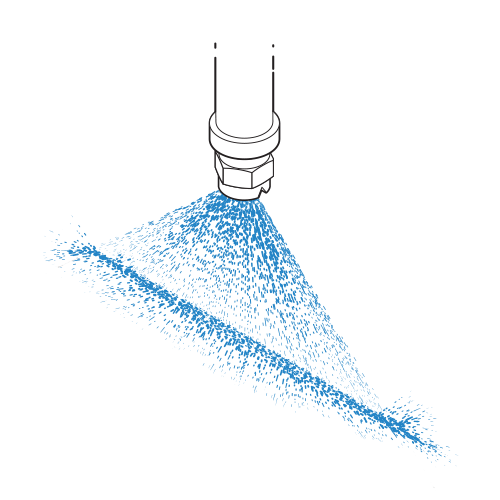
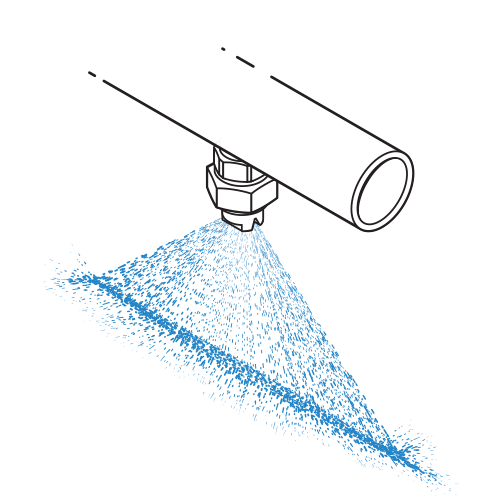
Hydraulic descaling systems use high-pressure water jets — typically operating between 80 and 400 bar (1,160–5,800 psi), with modern high-performance systems capable of reaching 450 bar or above — directed through flat fan nozzles arranged on descale headers. The nozzles must deliver a uniform, high-impact spray curtain that strips the scale cleanly from the steel surface as it passes through the rolling mill. Scale removal works through a combination of mechanical impact from the high-velocity water jet and thermal shock: the rapid cooling of the surface oxide layer creates differential thermal contraction between the scale and the underlying steel, generating shearing forces that help break the scale free.
Why it matters: Incomplete descaling shows up as rolled-in scale defects downstream – a costly, avoidable quality failure.
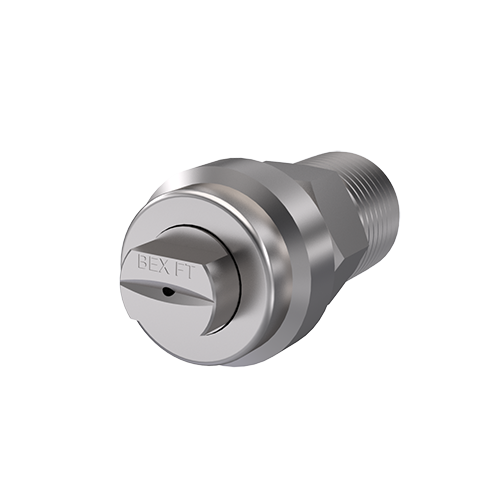
The BEX F Series flat fan nozzles are the standard choice for descaling applications. These precision-machined nozzles are available in spray angles from 0° (solid stream) through 110°, with the narrower angles (15°–40°) typically preferred for descaling because they concentrate the spray force into a tighter impact zone. For applications requiring chemical resistance or extreme durability, the F Series is available in 303 and 316 stainless steel. Contact BEX to confirm whether a suitable nozzle option is available for your operating pressure.
Continuous casting — the process of solidifying molten steel into slabs, billets, or blooms — is arguably the most nozzle-intensive operation in a steel mill. As liquid steel exits the mold, it forms a thin solidified shell surrounding a still-molten core. Secondary cooling spray zones below the mold use hundreds of nozzles to apply controlled amounts of water to the strand surface, extracting heat at a rate that ensures uniform solidification without thermal stress cracking.
The cooling must be remarkably uniform. Hot spots cause the shell to thin and risk breakouts (where molten steel bursts through the shell), while overcooling creates internal stress and surface cracks (see also). The nozzle spray pattern, flow rate, and droplet size must all be carefully matched to the casting speed, steel grade, and strand geometry.
Why it matters: Uneven secondary cooling lets hot spots form and the solidifying shell thin unevenly - the direct cause of a breakout, where molten steel escapes through the shell. It’s one of the most dangerous and costly failures a caster can have.
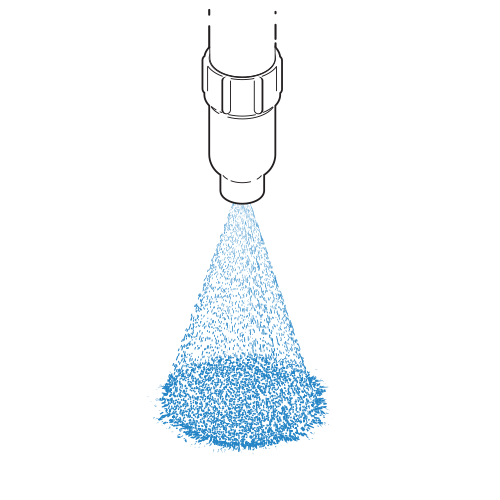
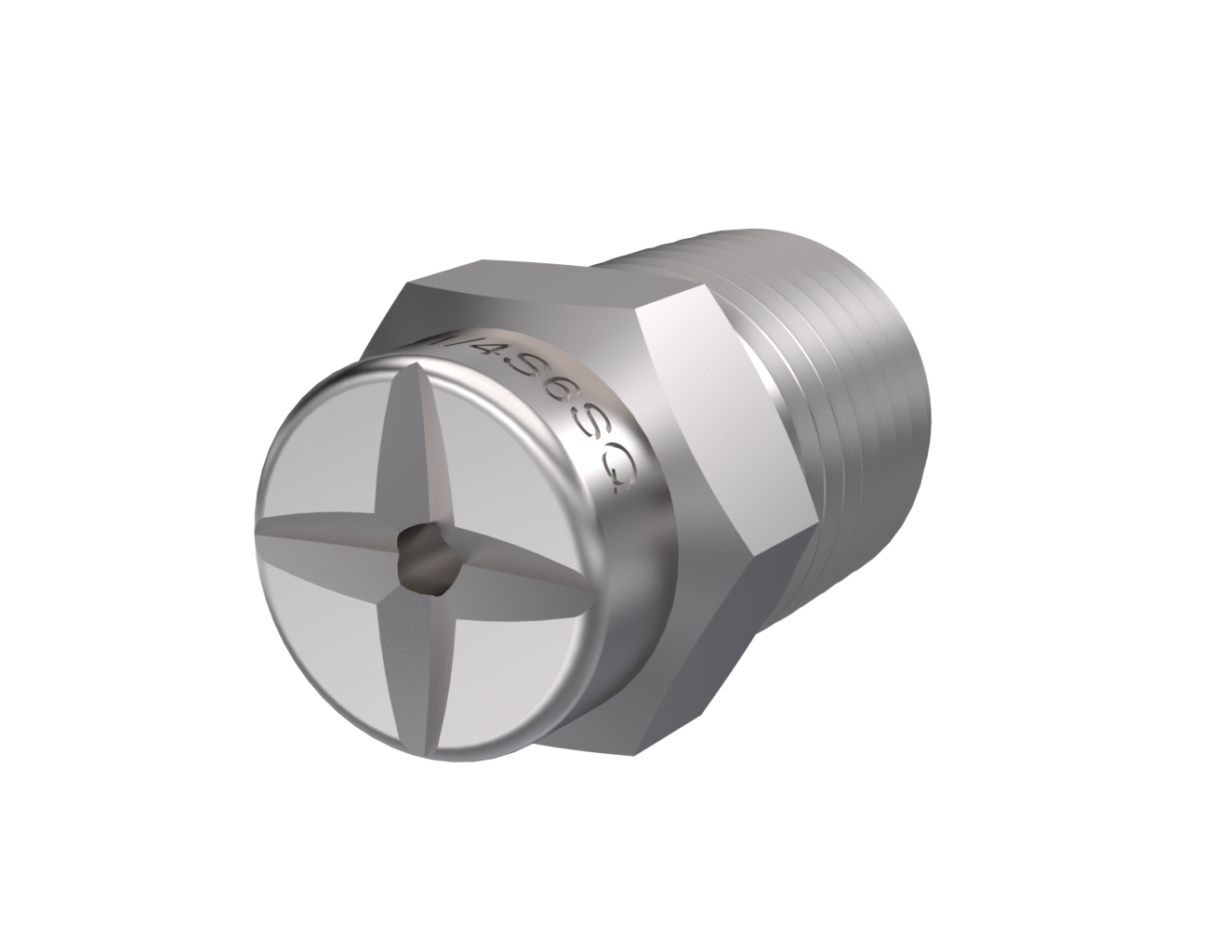
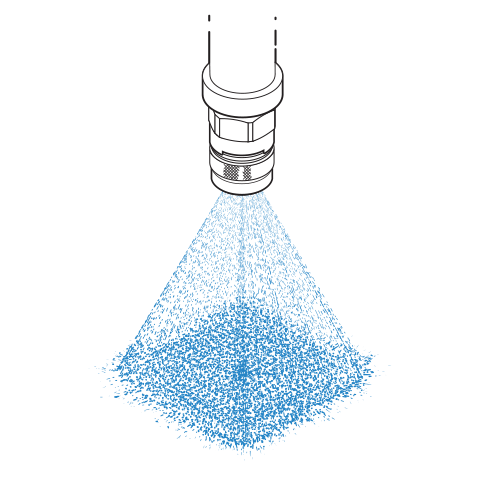
For wider strand widths or slab casting, the larger FS Series full cone nozzles (available in 1-1/4" through 4" connections) provide the higher flow rates needed. The SW and SQ Series (wide-angle and square spray full cone variants) offer alternative coverage geometries for specific machine configurations.
After hot rolling, steel strip or coil is passed through a pickling line where hydrochloric or sulfuric acid is sprayed onto the surface to dissolve residual oxide scale. This chemical cleaning step is essential before cold rolling, galvanizing, or other finishing operations.
Pickling nozzles must withstand highly corrosive acid environments while delivering a uniform spray pattern that ensures complete and even scale removal across the full width of the strip. Nozzle material selection is critical — standard stainless steel will corrode rapidly in hot acid service.
Why it matters: standard stainless corrodes rapidly in hot acid – material choice here is not optional.
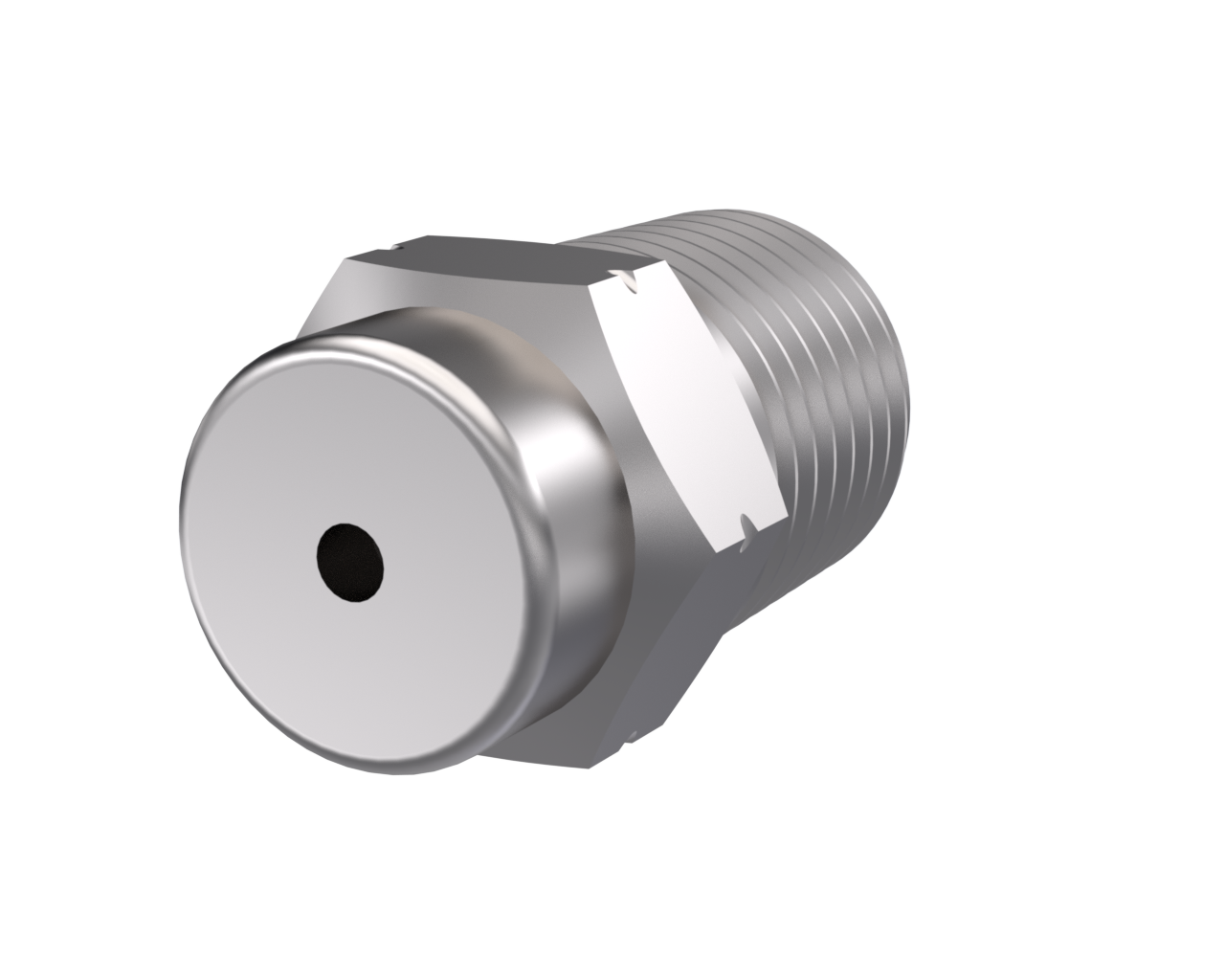
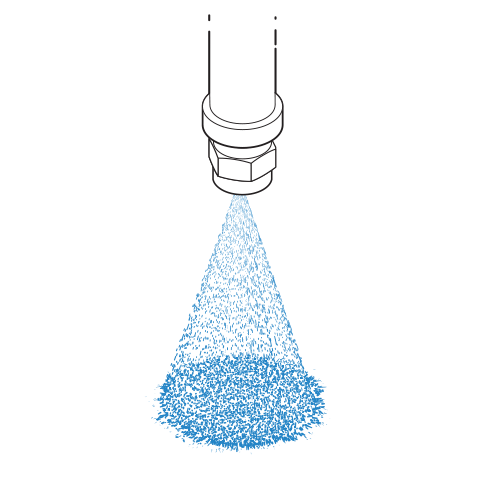
For acid spraying applications, BEX offers the F Series flat fan nozzles and S Series full cone nozzles in corrosion-resistant materials including PVDF (polyvinylidene fluoride), commonly called kybar, and Hastelloy C-276 for severe acid service. The injection molded FT Series flat fan nozzles provide an economical alternative for less aggressive acid concentrations, and their all-plastic construction eliminates metal corrosion entirely. BEX also offers these nozzles in CPVC and polypropylene for various acid resistance requirements.
Rolling mill rolls endure enormous mechanical and thermal stress. Without proper cooling, rolls can develop thermal fatigue cracks, suffer premature wear, or lose their dimensional profile — all of which degrade product quality and increase maintenance costs. Spray nozzles are used to apply cooling water to the roll surface between passes, and the spray must be carefully controlled to avoid thermal shock while still removing enough heat.
Why it matters: under-cooled rolls wear faster and can pass thermal stress straight into the strip, so a cooling shortfall shows up twice - as a maintenance cost on the mill and as a quality defect in the product.
The F Series flat fan nozzles in narrow spray angles (15°–25°) are commonly used for roll cooling, as the concentrated spray pattern can be directed precisely at the roll surface.
In integrated steel mills with coking operations, red-hot coke pushed from the coke ovens must be rapidly quenched with large volumes of water to stop the combustion process and cool the coke for handling. This is one of the highest-flow-rate applications in a steel mill, and the nozzles must handle enormous water volumes while withstanding the thermal shock of contact with material at approximately 1,000–1,200°C (Nippon Steel Engineering).
Why it matters: quenching water is rarely pristine - it often carries scale and particulate - so a nozzle that clogs doesn’t just underperform, it slows the entire coking cycle and the ovens behind it.
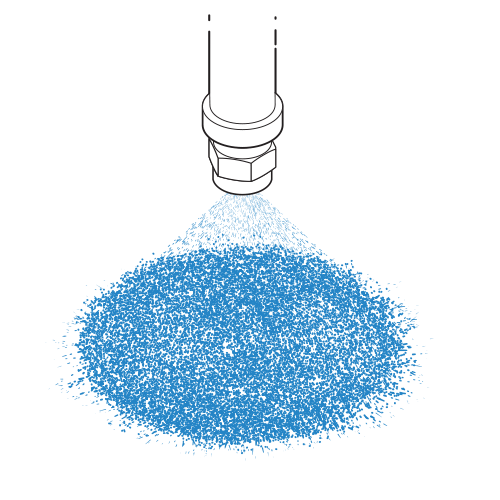
The FS Series large-capacity full cone nozzles (in 2-1/2" through 4" pipe sizes) and the R Series large-capacity hollow cone nozzles are designed for exactly this type of high-volume application. Their robust construction and large free-passage diameters resist clogging even with less-than-pristine water supplies — a common reality in coke quench operations.
Steel mills generate significant volumes of flue gas containing particulates, sulfur compounds, and other pollutants. Gas washing systems — also called wet scrubbers — use spray nozzles to inject water or chemical solutions into the gas stream, capturing pollutants before the gas is released to atmosphere. Effective gas washing requires thorough coverage of the gas cross-section with appropriately sized droplets: too fine and the droplets are carried away with the gas; too coarse and they fall through without adequate contact time.
Why it matters: droplet size is the whole job here - too fine and the droplets get carried away with the gas before capturing anything; too coarse and they fall through the stream without enough contact time to work.
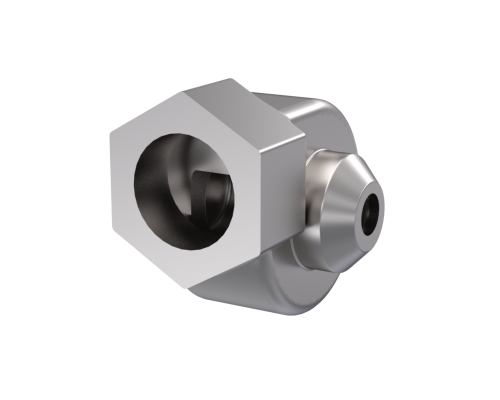
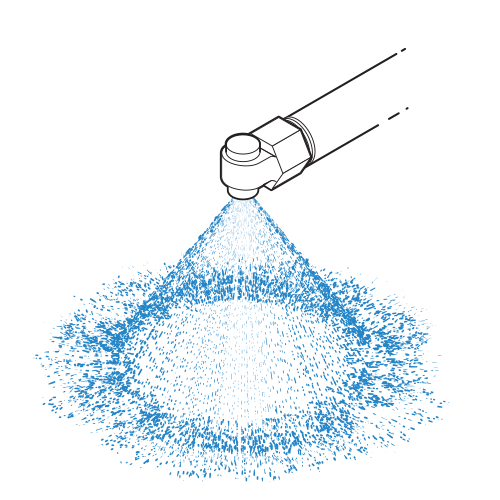
The S Series full cone nozzles provide the uniform, medium-droplet spray pattern that gas washing systems demand. For larger duct cross-sections, the YS Series spiral (Twister) nozzles are an excellent choice — their unique clog-free design (no internal vanes or small orifices) makes them virtually maintenance-free even when spraying dirty, particulate-laden water, and they produce a wide, full cone pattern with a range of droplet sizes that promotes effective gas-liquid contact. The spiral design also means these nozzles maintain their spray pattern even at reduced pressures, providing operational flexibility.
Grey iron foundries share many spray requirements with steel mills but also have unique needs (foundry mold cooling techniques). Casting cooling — applying water spray to freshly poured castings to accelerate solidification and cooling — requires nozzles that can handle the dust, sand, and particulate-laden air of a foundry environment. Mold finish spraying applies release agents or coatings to mold surfaces before pouring, requiring fine, uniform coverage. Pattern oiling uses spray nozzles to apply a thin film of oil to wooden or metal patterns to facilitate clean release from molding sand.
Why it matters: foundry air is dirtier than a mill’s, so clog resistance matters as much as spray pattern for cooling - and mold oiling adds a precision-coverage requirement of its own; too little oil and the casting sticks, too much and material is wasted.
For casting cooling, the S Series full cone nozzles deliver the broad, uniform coverage needed. For mold finish spraying and pattern oiling where finer atomization is required, the JPL Series air atomizing nozzles produce precisely controlled fine mist patterns that minimize overspray and material waste. The F Series flat fan nozzles are also used for coating applications where a flat, even film is needed across a surface.
Both steel mills and foundries must manage hot exhaust gases before they reach pollution control equipment. Injecting water spray into the gas stream reduces the temperature — protecting downstream equipment like baghouses (fabric filters) that cannot tolerate excessive heat — and can also suppress visible smoke emissions.
Why it matters: a baghouse’s fabric filters simply can’t tolerate excessive heat, so gas cooling isn’t optional upstream of one - and because the same spray also controls visible smoke, an equipment-protection problem and an emissions-compliance problem ride on the same nozzle.
The YS Series spiral nozzles excel in gas cooling applications because their open spiral design resists clogging (a critical advantage in dusty exhaust streams) and produces a well-distributed spray pattern even at low pressures. For smaller duct applications, the S Series full cone nozzles provide reliable, uniform cooling spray.
Although continuous casting has largely replaced ingot casting, some specialty steel operations still use ingot molds. These molds must be cooled between pours and treated with rust inhibitors to maintain their surface quality. In foundries, rust inhibition is applied to machined surfaces and stored castings to prevent corrosion during storage and shipping.
Why it matters: a mold that isn’t properly cooled and rust-inhibited between pours degrades faster and can transfer surface defects to the next ingot - and in a foundry, the same lapse shows up later as corroded castings by the time they reach a customer.
Nozzle material selection is as important as nozzle type selection in steel mill and foundry environments. BEX offers nozzles in a range of materials to match the application:
| Material | Best for |
|---|---|
| Brass | Suitable for clean water applications at moderate temperatures, such as fire protection systems that see infrequent use. |
| 303 Stainless Steel | A good general-purpose choice for most mill water applications where moderate corrosion resistance is needed. |
| 316 Stainless Steel | Preferred for more corrosive environments, including acid-containing spray applications and areas exposed to aggressive chemicals. Also available in a hardened variant for high-wear applications like descaling, where abrasive particles in recirculated water rapidly erode standard nozzle orifices. |
| Hardened Stainless | The top choice for high-wear applications like descaling, where abrasive particles in recirculated water rapidly erode standard nozzle orifices. |
| PVDF/Kybar and CPVC PVC | Used in acid spray applications where metal nozzles would corrode. |
Spray nozzles are quietly essential to nearly every stage of steel and iron production — from the violent quenching of red-hot coke to the precision cooling of a continuous casting strand, from stripping oxide scale at hundreds of bar to washing pollutants from exhaust gas. Selecting the right nozzle type, spray pattern, flow rate, and material for each application is a decision that directly affects product quality, energy efficiency, environmental compliance, and maintenance costs.
BEX Engineering manufactures a comprehensive range of spray nozzles specifically designed for the demands of steel mills and foundries. Whether you need a high-impact descaling nozzle, a clog-resistant gas washing spiral, or a precision air atomizing nozzle for mold release — BEX has the product and the expertise to help you get it right.
For assistance selecting the right nozzle for your steel mill or foundry application, contact BEX Engineering today.