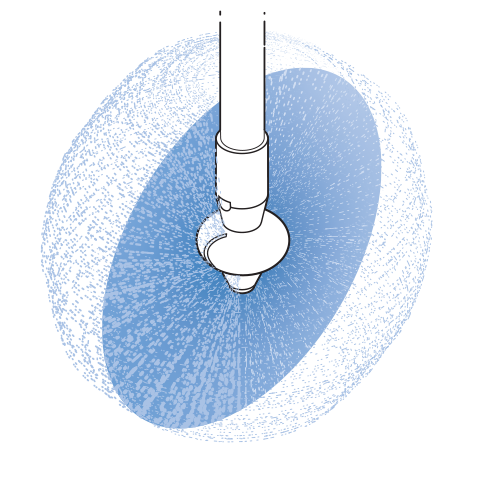
Mining and quarrying are foundational industries — they extract the raw materials upon which virtually every other sector depends. Whether the operation involves coal mining underground, surface mining of metal ores, quarrying stone and gravel, or producing ready-mix concrete, these industries share a common set of challenges where spray nozzles provide critical solutions: dust control, material washing, equipment cleaning, and environmental compliance. In this article, we examine the key spray nozzle applications across coal mining, surface mining, quarries, and concrete operations, and recommend the specific BEX Engineering products best suited to each.
If there is one application that unites every operation in this group, it is dust control. Airborne particulate matter is the single largest environmental and occupational health concern in mining, quarrying, and concrete production. Regulatory bodies worldwide impose strict limits on dust emissions, and the consequences of non-compliance range from fines to operational shutdowns.
Dust is generated at virtually every material handling point: blasting, loading, dumping, crushing, screening, conveyor transfer, stockpiling, and vehicle traffic on haul roads. Effective dust suppression requires delivering water (often with a surfactant additive to improve wetting) as a fine mist that captures airborne particles without saturating the material — excess moisture can cause handling problems, increase shipping weight, and degrade product quality.
The physics of dust suppression are straightforward: a water droplet is most effective at capturing a dust particle when the two are of similar size. Very fine dust (PM10 and PM2.5 — particles smaller than 10 and 2.5 micrometers respectively) (see also: PM10 dust control in mines) therefore requires very fine spray droplets, while coarser visible dust can be controlled with somewhat larger droplets. Nozzle selection must account for this particle size matching, as well as the wind conditions, spray throw distance, and water availability at each suppression point.
When ore, coal, gravel, or sand is dumped from trucks or loaders into hoppers, bins, or stockpiles, the impact displaces air and launches a cloud of dust. Nozzles positioned around the dumping zone wet the dust-producing surface, suppressing dust at the source before it becomes airborne.
Why it matters: dust suppressed at the point of impact never gets the chance to become airborne in the first place — try to catch it after it's already over the stockpile and you're chasing a much harder, much less effective problem.
The H Series hollow cone nozzles produce the fine droplet sizes (typically 100–300 micrometers VMD at standard operating pressures) needed for effective airborne dust capture. For installations where rapid nozzle changeout is desirable — such as mobile crusher setups that are frequently relocated — the ZH Series quick-connect hollow cone nozzles allow tool-free installation. Where extremely fine fog is needed for sub-10-micrometer dust, the JPL Series nozzles produce droplets in the 10–50 micrometer range, though they require a compressed air supply.
Conveyor systems are the arteries of any mining or quarrying operation, and every transfer point — where material drops from one conveyor to the next — is a dust generation source. Spray nozzles are installed at enclosures around transfer points to wet the dust-producing surface within the chute, suppressing dust at the source before it escapes to the environment.
Why it matters: an enclosed transfer point only stays enclosed if the spray inside it actually knocks the dust down — miss that and the dust finds the gaps in the enclosure instead of staying inside it.
The H Series hollow cone nozzles and S Series full cone nozzles are both used at conveyor transfer points. The hollow cone produces finer droplets for better dust capture, while the full cone provides broader coverage of the transfer chute interior. For dusty environments with recirculated water supplies that may contain suspended solids, the YS Series spiral nozzles offer the advantage of clog-resistant operation — their open spiral passage cannot be blocked by particles that would jam a conventional nozzle orifice. F Series and FL series are also often used.
Unpaved haul roads at mines and quarries generate enormous quantities of dust from heavy vehicle traffic. Water trucks fitted with spray bars apply water to the road surface to keep dust down. The nozzles must provide wide coverage to spray the full road width in a single pass, and the spray must penetrate the road surface rather than merely wetting the top — otherwise the dust returns within minutes as the surface dries.
Why it matters: a spray that only wets the surface buys a few minutes at best — the water has to penetrate into the road material, or the dust is back the moment the top layer dries.
In surface mining and quarrying, the raw extracted material must be washed to remove clay, dirt, and fines before it can be sold or further processed. Vibrating screens are the most common washing equipment — material passes over the screen while spray nozzles direct water onto the material from above, washing away unwanted fines that pass through the screen mesh.
Effective screen washing requires uniform water coverage across the full width of the screen deck. Nozzles must be spaced and angled to ensure no dry strips where unwashed material could pass through. The water pressure and flow rate must also be sufficient to dislodge clay and adhered fines from the rock surfaces.
Why it matters: a single dry strip across the screen deck is enough to let unwashed material straight through — coverage has to be complete across the full width, not just adequate on average.
The F Series flat fan nozzles in medium spray angles (40°–80°) are the workhorse for vibrating screen washing. Their flat spray pattern can be oriented perpendicular to the material flow direction, creating a curtain of water that material must pass through. Multiple nozzles are spaced across the screen width with overlapping spray patterns to ensure complete coverage. For heavy-duty applications with very cohesive clay, higher-impact narrow-angle nozzles (15°–25°) can be used to provide the additional force needed to break clay bonds. FP flat fan nozzles are also commonly used because they are high impact.
In some surface mining operations, high-pressure water jets are used to break up and transport ore or overburden — a technique called hydraulic sluicing or monitor mining. The nozzles used are typically large, solid-stream types designed to deliver maximum impact force at distance.
Why it matters: the technique depends entirely on the jet holding its force out to the target distance — a stream that disperses too early doesn't have the impact left to break up rock or overburden at all.
The F Series 0° (solid stream) nozzles deliver a coherent, high-velocity stream with maximum impact at the target. For sluicing applications, these are typically specified in larger pipe sizes (3/8" to 3/4") to provide the high flow rates needed.
Before material can be mined or quarried at all, the rock must first be broken — and in most hard rock mining and quarrying operations, that means drilling and blasting. ANFO (Ammonium Nitrate Fuel Oil) is the most widely used bulk blasting agent in surface and underground mining, valued for its low cost, safety, and reliable performance in dry borehole conditions.
The BEX Compact ANFO Loader is a pneumatic bulk explosive loader designed to load ANFO efficiently into small-diameter boreholes. Operating on compressed air at 60–120 PSI — the same air supply already present at most drill sites — the loader draws ANFO from a 25 kg hopper and delivers it through an anti-static loading hose at high velocity. The prills fracture upon impact with the bottom of the hole, producing a high-density packing that reduces the risk of misfires, improves rock fragmentation, and lowers mucking costs.
The loader weighs just 5 kg and is designed for single-operator use, loading a typical hole in 15–20 seconds. Three ejector element sizes accommodate a range of borehole diameters:
The loader disassembles quickly for cleaning and maintenance, and all fasteners are stainless steel for durability in the mine environment. BEX has been manufacturing ANFO loaders since 1965 — the same engineering standards and commitment to reliability that define BEX spray nozzle products extend to the ANFO Loader line. For full specifications, assemblies, and replacement components, connect with one of our experts.
Coal preparation plants (washeries) use vibrating screens extensively to classify coal by size and to wash away rock, clay, and other refuse. The nozzle requirements mirror those for quarry screen washing, with the additional consideration that coal is a softer material that can be broken by excessive spray impact — so the balance between cleaning effectiveness and material damage must be carefully managed.
Why it matters: coal is soft enough that the same spray force that cleans a hard-rock screen can start breaking down the coal itself — too much impact trades washing effectiveness for product loss.
Medium-impact F Series flat fan nozzles at moderate pressures (1–3 bar) provide effective washing without excessive material degradation. The FT Series injection molded flat fan nozzles offer an economical alternative for coal wash plants that use large numbers of screen spray nozzles and replace them frequently due to the abrasive environment.
Ready-mix concrete operations present a unique set of spray challenges. Concrete is highly alkaline (pH 12–13) and abrasive, and it hardens rapidly once it begins to set. Every piece of equipment that contacts wet concrete — mixer trucks, chutes, hoppers, and plant equipment — must be washed promptly and thoroughly to prevent concrete buildup.
Ready-mix trucks are washed out after every delivery to prevent concrete from hardening inside the drum and on the exterior chutes. Wash-down stations use spray nozzles (see: automated truck wash systems; concrete washout practices) to deliver high-volume, moderate-pressure water both inside the drum (through the drum opening) and over the truck exterior.
Why it matters: concrete that isn't washed off before it sets doesn't come off in the next wash cycle — it has to be chipped or ground away, so the spray's job is really a race against the concrete's set time.
For exterior wash-down, the F Series flat fan nozzles in wide spray angles provide broad coverage. For drum interior cleaning, the TWK Series tank washing nozzles can be inserted into the drum to provide 360° cleaning coverage — their rotating spray pattern reaches all interior surfaces. For simpler setups, solid stream nozzles at higher pressures are used to blast residual concrete from chutes and surfaces. FB Nozzles are also often used.
Precise water addition to the concrete mix is critical — too much water weakens the concrete; too little makes it unworkable. Spray nozzles used for water addition to mixing systems must deliver accurately metered and evenly distributed water.
Why it matters: water addition here is a mix-design problem as much as a spray problem — too much water and the batch loses strength, too little and it's unworkable, with very little margin between the two.
The S Series full cone nozzles provide uniform water distribution into mixing drums and hoppers. Their predictable flow rate at a given pressure allows precise water metering when used with calibrated pressure regulation.
Cement dust and aggregate dust are generated during batching and mixing operations. The same dust suppression principles used in mining apply here, with the added consideration that cement dust is highly alkaline and can irritate skin, eyes, and respiratory systems.
Why it matters: cement dust isn't just a visibility or housekeeping nuisance — it's caustic, so suppressing it at the batch plant is a direct worker-safety control, not only an environmental one.
Coal mines present a particularly acute fire and explosion risk due to the combustible nature of coal dust and the presence of methane gas in underground operations. Mine shaft fire protection systems use spray nozzles as part of deluge and suppression systems designed to control fires and prevent the propagation of coal dust explosions.
Why it matters: these nozzles can sit in standby for years before they're ever called on, and when they are it's to stop a coal dust explosion from propagating — there's no acceptable failure mode for a nozzle with that job.
The S Series full cone nozzles and H Series hollow cone nozzles are used in mine fire protection systems. The full cone pattern provides area coverage for surface wetting, while the hollow cone's finer droplets are more effective at cooling the atmosphere and suppressing flame propagation. All nozzles for fire protection service should be specified in stainless steel to ensure reliable operation after potentially years of standby service. YS nozzles are also often used.
Quarries producing washed gravel and sand for construction use spray nozzles not only for screen washing (as described above) but also for managing the slurry waste stream. Slurry — a mixture of fine particles and water — must be directed to settling ponds or treatment systems, and spray nozzles are sometimes used to distribute slurry across settling beds for dewatering.
Why it matters: a slurry nozzle that clogs doesn't just stop spraying — it backs up the dewatering process behind it, since the settling beds depend on that slurry actually reaching them.
For slurry distribution, the YS Series spiral nozzles are the clear choice. Their large, open flow passages handle the high-solids-content slurry without clogging — a common failure mode for conventional nozzles in this application. For clean gravel washing on screens, the F Series flat fan nozzles remain the standard. FP nozzles are also often used for their high impact.
At many quarry and mine sites, regulations require that trucks be washed before leaving the site to prevent tracking mud and debris onto public roads. Undercarriage wash systems use nozzles mounted in a drive-over pit to spray the truck's underside as it passes through.
Why it matters: this is a regulatory requirement, not a courtesy rinse — a truck that still tracks mud onto public roads after going through the wash means the spray didn't do the one job it's there for.
Upward-facing F Series flat fan nozzles and FP flat fan nozzles at moderate to high pressure (3–10 bar) provide the impact force needed to dislodge mud and clay from undercarriage components. The FL series nozzles are an alternative where maximum clog resistance is needed — the open deflector design handles the dirty recirculated water common in truck wash systems.
Mining and quarry spray environments are characterized by abrasive water, heavy particulate loading, vibration, and physical abuse. Nozzle material and construction must be matched accordingly:
| Material | Best for |
|---|---|
| 316 Stainless Steel | The standard for most applications, providing corrosion resistance and mechanical durability. |
| Hardened Stainless | Recommended for high-wear applications like screen washing where abrasive slurry rapidly erodes standard orifices. |
| Injection Molded Plastic (FT Series) | An economical, corrosion-proof option for coal wash and dust suppression systems where nozzles are treated as consumable wear items and replaced frequently. |
| Brass | Suitable for clean-water dust suppression systems and fire protection where cost is a consideration and chemical resistance is not critical. |
Mining, quarrying, and concrete operations depend on spray nozzles for some of their most critical operational needs — from keeping workers safe and regulators satisfied through effective dust control, to ensuring product quality through thorough material washing, to protecting equipment and assets with fire suppression systems. The right nozzle selection, accounting for spray pattern, droplet size, flow rate, clogging resistance, and material durability, directly impacts operational efficiency and compliance.
BEX Engineering provides a full range of spray nozzle solutions engineered for the demanding conditions of resource extraction and construction materials. Contact BEX Engineering to discuss your specific dust control, washing, or process spray requirements.