Industrial bakeries are, at their core, precision manufacturing environments. Producing consistent, high-quality baked goods at scale — whether bread, rolls, pastries, cakes, cookies, or crackers — requires exact control over temperature, humidity, coating weight, and sanitation at every stage of the process. Spray nozzles are present throughout: creating the crust on an artisan loaf, glazing a pastry, lubricating a conveyor, blowing crumbs from a slicing blade, and sanitizing the equipment that makes it all food-safe. In this article, we examine the key spray nozzle applications in industrial bakery operations and identify the specific BEX Engineering products best suited to each task.
Humidity is one of the most critical and least visible process variables in a bakery. Too little moisture at the wrong moment and dough skins over, crusts set prematurely, and products emerge with split sides and poor volume. Too much humidity at the wrong stage and products stick, take on moisture during cooling, and arrive at packaging with shortened shelf life. Getting humidity right — at the right level, in the right location, at the right time — is a defining challenge of industrial bakery engineering.
The proof cabinet or proofer is where shaped dough pieces undergo their final fermentation, roughly doubling in volume as yeast produces carbon dioxide. This process requires a carefully controlled environment: typically 35–43°C (95–110°F) and relative humidity of at least 80% to prevent skins from forming on the dough during the final proofing stages. If humidity drops below this threshold, the outer surface of the dough dries and forms a skin that cannot stretch uniformly during proofing or oven spring — the result is a product with a split or scarred crust, asymmetric shape, and reduced volume. Atomized water is sprayed from nozzles to maintain the dough’s moist external surface, with the formation of a dry skin being a direct indication of an improperly functioning humidification system.
In large industrial tunnel proofers, maintaining uniform humidity throughout a chamber that may be 30–60 meters long is a genuine engineering challenge. Nozzles must produce a very fine mist that evaporates rapidly to create true water vapor rather than depositing liquid water on the dough surface — wet dough pieces stick to the conveyor belt and to each other, causing significant production losses.
Why it matters: let humidity drop and the dough skins over, so it can't stretch in the oven — but mist that lands as liquid makes pieces stick to the belt and each other, and either way the product that comes out is scrap or seconds.
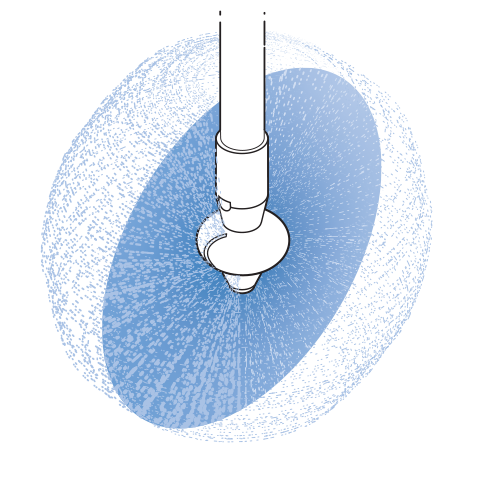
The BEX H Series hollow cone nozzles at low operating pressures (1–2 bar) produce the fine, low-volume mist needed for proofer humidification without wetting dough surfaces. The C Series hollow cone nozzles at operating pressures of 3 bar + can also be used. Their small orifice sizes and predictable flow rates allow system designers to calculate the exact moisture input needed to maintain target RH levels. Where even finer atomization is required — particularly in long tunnel proofers where the mist must remain airborne long enough to distribute evenly before evaporating — the BEX JPL Series air atomizing nozzles produce ultra-fine droplets (10–50 μm) that become water vapor almost immediately, providing precise humidity control with zero risk of surface wetting. The independent air and liquid controls of the JPL Series allow fine-tuning of the humidification rate as ambient conditions change.
Steam injection at the beginning of the baking cycle is one of the oldest and most important techniques in bread baking. Steam keeps the surface of the dough moist and flexible, delaying crust formation and allowing maximum oven spring — the final burst of volume increase driven by rapid gas expansion and yeast activity before the crust sets. It also gelatinizes the starch on the exterior of the loaf without forming a hard shell. After the steam is removed, the gelatinized layer dries out, forming a thick, crunchy crust. Steam injection is performed in the first zone of an industrial tunnel oven, which can be up to 30–40 meters long and is typically split into three zones allowing the baker to alter the bake profile throughout the chamber.
The nozzles used for oven steam injection must produce a fine, uniform spray that distributes moisture across the full width of the baking band without creating large droplets that cause steam blisters on the crust surface. They must also withstand continuous exposure to temperatures above 200°C and to the condensed steam environment inside the oven.
Why it matters: steam in the first oven zone is what gives bread its volume and crust, and large droplets that don't flash to steam leave blisters on the crust instead.
The BEX H Series hollow cone nozzles in 316 stainless steel are the standard choice for oven steam injection, providing the fine, uniform droplet distribution needed for effective crust development across the full width of the baking band. For applications requiring finer, more precisely controlled steam distribution, the BEX JPL Series air atomizing nozzles deliver superior atomization, ensuring moisture reaches all parts of the oven chamber uniformly without pooling on the oven floor or the product surface. The BEX C Series hollow cone nozzles can also be used.
After baking, products must be cooled before slicing or packaging. In ambient-air spiral coolers and cooling tunnels, the relative humidity of the cooling air must be controlled: if it is too low, the product loses excessive moisture weight (reducing yield) and the crust becomes excessively hard; if it is too high, condensation risks increase. A fine mist introduction system that raises the humidity of the incoming cooling air to a target level allows precise control of this balance without introducing free liquid that could compromise product quality or food safety.
Why it matters: air that's too dry pulls moisture out of the product and costs yield by weight, while free liquid that condenses on warm product creates a food safety and shelf-life problem.
The BEX JPL Series air atomizing nozzles are ideal for cooling tunnel humidification, producing the ultra-fine mist needed to raise air humidity without introducing any free liquid that could condense on products. Their 316 stainless steel construction is appropriate for the food environment, and their compact size suits installation in the tight confines of a spiral cooler air inlet.
A bakery is, among other things, a precision coating operation. Almost every product that emerges from an industrial bakery has been sprayed with something: a release agent to prevent sticking, a wash to develop color and sheen, a glaze to add sweetness or extend shelf life, an oil to lubricate the conveyor. Each of these applications has its own requirements for droplet size, coverage uniformity, flow rate, and spray pattern.
Bread pans, cake tins, muffin trays, and baking sheets must be coated with a release agent — typically a vegetable oil-based compound, a lecithin emulsion, or a proprietary baking release spray — before each use to prevent dough or batter from adhering. The release coating must be thin, uniform, and complete: any missed areas result in product sticking and tearing during demolding. Excess oil in the corners of a bread tin creates a fried rather than baked crust on the bottom of the loaf, a defect immediately visible and noticeable in eating quality.
Why it matters: a missed spot means the product sticks and tears when it's demolded, while excess oil pooled in the corners fries the base of the loaf — both are visible defects on every affected pan.
The BEX F Series flat fan nozzles in food-grade 316 stainless steel are the standard choice for pan release agent application on automated pan greasing machines. Their flat, tapered spray pattern can be oriented to cover the full length of a pan in a single pass as it travels beneath the nozzle on a conveyor. For release agent application where the spray must conform to complex pan geometries — muffin trays, fluted cake tins, loaf pans with steep sides — the BEX JPL Series air atomizing nozzles produce the fine mist needed to reach recessed areas and undercut surfaces that a flat fan spray cannot fully coat. BEX FT Series flat fan nozzles are often used in the coating operations as they can be fitted to the pneumatic spray guns used.
Egg wash and water wash applied to dough pieces before baking promote browning through the Maillard reaction — a chemical reaction between reducing sugars and amino acids occurring at the product surface during baking that produces the characteristic golden-brown color and flavor of a well-baked crust. Egg washes in particular yield a glossy shine on products such as challah, and help toppings such as seeds and salt crystals adhere to the surface. The spray must be applied uniformly and at the correct rate — too little and the browning is uneven; too much and the product surface becomes wet and sticky, causing pieces to join during baking or picking up conveyor belt marks.
Why it matters: browning follows the wash, so an uneven spray shows up directly as blotchy colour, while over-application makes pieces sticky enough to join in the oven or pick up belt marks.
The BEX F Series flat fan nozzles provide the uniform, consistent coverage needed for egg wash and water wash application across the full width of the product conveyor. Wide-angle variants (65°–110°) allow a single nozzle or a small number of nozzles to cover the full conveyor width without dry strips or overlap zones that result in uneven browning. The larger-orifice F Series models are specified for viscous egg-based washes to ensure reliable operation through extended production runs without maintenance interruptions. FB Series flat fan nozzles can also be used if higher impact is needed.
Many baked goods receive a coating after baking: sugar glaze on doughnuts and Danish pastries, high-gloss confectioner’s glaze on premium rolls, oil spray on crackers and flatbreads to add color, flavor, and a fresh appearance. Post-bake coatings present different challenges from pre-bake washes: the product is hot, the coating must adhere to a dry and often porous surface, and the application must be fast enough to match the production line speed.
Why it matters: on a hot, porous product at line speed, a coating that pools, runs, or misses spots is immediately visible — and every extra gram of glaze applied is ingredient cost multiplied across the whole run.
For thin, uniform post-bake coatings including oil sprays and liquid sugar glazes, the BEX FT and ST Series tips are used as they can be fitted to spray guns. Where finer atomization is needed — for example, applying a thin glaze that must not pool in surface crevices or create runs on a decorative product — the BEX JPL Series air atomizing nozzles provide superior droplet control, minimizing material use while achieving complete and even coverage.
Baking tins, trays, and mold containers must be washed and rinsed before reuse. Food residues baked onto pan surfaces attract microbial contamination and, if not removed, build up over successive bakes into increasingly hard deposits that affect heat transfer and release performance. Automated pan washing machines use spray nozzles to direct cleaning solutions and rinse water across the interior and exterior surfaces of pans as they travel through the washer on a conveyor.
Why it matters: baked-on residue left on a pan builds up bake after bake, hurting release and heat transfer and giving microbes a place to live on a surface that goes straight back into production.
The BEX TWK Series rotating tank washing nozzles — available in threaded and sanitary (tri-clamp) connections, in both 316 stainless steel and all-PTFE (Teflon) construction — provide 360°, 270°, or 180° coverage patterns to thoroughly rinse the interior of baking tins and trays in automated washers. Their rotating solid-stream jets deliver higher impingement than static spray balls, removing baked-on residues more effectively with lower water consumption. For smaller items such as baking cups or specialty molds, the SN4922 Clean-in-Place nozzle disperses multiple solid-stream sprays in a 252° radius from a single, compact 316 stainless steel body, providing high-impingement cleaning in a minimal installation footprint.
Industrial bakeries producing dairy-enriched products — brioche, croissants, enriched rolls, cream-filled pastries — incorporate dairy ingredients including milk, cream, and butter that are applied by spray at various process stages. Milk wash and cream wash applied before baking serve the same crust development function as egg wash, promoting browning and adding sheen. In dairy environments, nozzles are subject to more aggressive sanitation cycles because dairy residues are protein- and fat-rich and support rapid microbial growth, including Listeria monocytogenes, if not completely removed. Regulatory frameworks such as SQF and BRCGS explicitly require documented, validated cleaning processes for food-contact equipment in dairy applications.
Why it matters: dairy residues are rich in protein and fat and can support Listeria if not fully removed, so the nozzle has to be as easy to strip and clean as it is to spray with.
The BEX F Series flat fan nozzles in 316 stainless steel are the appropriate choice for milk and cream wash application, providing wide-angle coverage across the conveyor width in a single pass with a simple internal geometry that is straightforward to disassemble, inspect, and clean as part of the daily sanitation programme.
Conveyors throughout a bakery — product transport belts, slat conveyors, chain systems, and transfer points — must be lubricated to reduce friction, prevent product adhesion, and protect equipment from premature wear. Food-grade lubricant is applied by spray nozzle to the chain or belt surface. The application must be thin and even: excess lubricant contaminates the product; insufficient lubricant allows the chain to run dry and wear rapidly.
Why it matters: too much lubricant ends up on the product, too little lets the chain run dry and wear — and on a food line, lubricant in the wrong place is a contamination issue, not just waste.
The BEX F Series flat fan nozzles in narrow spray angles, directed along the conveyor surface or chain, apply a thin, even film of food-grade lubricant without over-spraying onto adjacent product or equipment surfaces. Their predictable flow rates at operating pressure allow the lubrication system to be engineered to deliver the precise lubricant dosage needed per unit length of conveyor.
Compressed air nozzles are a less visible but equally important class of spray equipment in industrial bakeries. Bakeries use compressed air in blow-off applications to remove surface moisture, clear debris from conveyor surfaces, and condition product surfaces before coating. In food manufacturing, compressed air that contacts product or product contact surfaces must meet food-grade standards — the air must be clean, dry, and oil-free — and the nozzle itself must deliver air efficiently. Compressed air is an expensive utility, and poorly designed or open-pipe air blow-off is wasteful compared to engineered nozzle solutions.
Before applying a coating, glaze, or topping, many bakery products benefit from a blow-off stage that removes loose surface crumbs, excess flour, or condensed moisture. Crumbs and flour on the product surface prevent glazes from adhering uniformly; surface moisture causes oil-based coatings to bead rather than spread. A compressed air blow-off station placed upstream of the coating application point ensures the product surface is clean and dry, improving coating adhesion and uniformity.
Conveyor belts accumulate crumbs, seeds, and product residue that must be cleared at scheduled intervals. Air nozzles deliver jets of high-impact air to targeted spots for directed blow-off, dislodging debris from conveyor surfaces into collection troughs. Effective blow-off requires concentrated, high-impact air delivered uniformly across the conveyor width — not a diffuse, low-velocity flow.
Why it matters: crumbs and moisture left on the surface stop glazes and oils from adhering evenly, and compressed air is expensive enough that inefficient open-pipe blow-off adds up quickly.
The BEX AirWisk nozzles produce a concentrated flat fan pattern of high-impact air specifically designed for cooling, drying, and blow-off applications. Available in ABS plastic (rated to 150°F / 66°C, maximum 100 PSIG), the AirWisk efficiently controls compressed air usage, reducing energy costs compared to open-pipe or poorly designed air nozzles while delivering the impingement force needed to dislodge crumbs, seeds, and debris from product surfaces and conveyor belts. Multiple AirWisk units can be mounted side by side on a manifold to provide coverage across the full width of a wide conveyor in a single installation. The 316 stainless steel models are specified wherever the air nozzle is adjacent to food products or product contact surfaces.
Between baking and packaging, product-contact components — slicing blades, depositor nozzles, embossing rollers, portioning heads — accumulate heat that can affect product quality or component performance. Slicing blades that become too warm cause the cut surface of bread to compress and distort rather than cut cleanly; depositor nozzles that overheat can cause fillings to partially set before dispensing. Directed compressed air cooling of these components extends service life and maintains product quality.
Why it matters: a warm slicing blade compresses bread instead of cutting it cleanly, and an overheated depositor can partially set a filling before it's dispensed — both show up as quality defects at line speed.
The BEX AirWisk nozzles — available individually or mounted in arrays — direct a concentrated flat fan of cooling air precisely at the component surface. Their efficient compressed air usage is particularly important for continuous-duty cooling applications operating throughout the production run. The compact design of the AirWisk suits installation in the confined spaces around depositors, slicers, and embossing equipment where space is often limited.
Sanitation is the overriding operational discipline in a food manufacturing facility. Every surface that product contacts, every piece of equipment that operates in the production environment, and every structure within the production space must be cleaned and sanitised on a defined schedule to prevent microbial contamination. Regulatory frameworks and global standards like SQF and BRCGS require documented, validated cleaning processes for food-contact equipment. CIP systems directly address these requirements by enabling standardised, automated cleaning with full traceability of critical parameters. In an industrial bakery, this means cleaning ovens, conveyors, mixers, dividers, moulders, proofers, slicers, and packaging machines — daily in most cases, with more thorough weekly or monthly deep cleans.
Why it matters: sanitation in a bakery is audited, not optional — SQF and BRCGS expect documented, repeatable cleaning, and any surface a spray can't reach reliably is a gap in that record.
For general equipment wash-down, the BEX F and FP Series flat fan nozzles and S Series full cone nozzles in 316 stainless steel provide the broad coverage and adjustable spray impact needed for manual and semi-automated cleaning operations. The ZF Series quick-connect flat fan nozzles are particularly useful in bakery plants where the same wash-down header must serve both high-pressure cleaning (narrow-angle, high-impact) and low-pressure rinsing (wide-angle, gentle) — their tool-free quick-change design allows operators to swap nozzle tips without interrupting the cleaning cycle. For automated CIP of enclosed process vessels, ingredient tanks, and proofer headers, the TWK Series rotating tank washing nozzles eliminate the need for confined space entry and provide validated, repeatable cleaning performance. The SN4922 Clean-in-Place nozzle is a compact single-piece 316SS option for high-impingement spray cleaning in smaller vessels and headers.
Food manufacturing places specific requirements on nozzle construction materials. All surfaces that contact food, food ingredients, or cleaning solutions must be of food-approved materials that will not corrode, leach, or harbour microbial contamination. In addition to food safety requirements, bakery-specific process fluids — alkaline CIP detergents, acidic rinse solutions, high-temperature steam, and sugary glazes — impose corrosion and fouling challenges that must be considered in material selection.
| Material | Best for |
|---|---|
| 316 Stainless Steel | The standard material for virtually all food-contact spray nozzles in a bakery. Corrosion-resistant to cleaning chemicals and food acids, dimensionally stable under oven temperatures and steam, and easy to inspect and clean. Specified for all food-contact and clean-room applications. |
| PTFE (Teflon) | Required in all-PTFE TWK Series models where absolute non-contamination of the cleaning circuit is essential. Chemically inert to virtually all food ingredients and cleaning agents. |
| ABS Plastic (AirWisk) | Appropriate for compressed air nozzles in non-food-contact applications (blow-off of equipment surfaces away from product). Rated to 150°F / 66°C and to 100 PSIG. |
| Brass | Not recommended for food-contact applications due to potential for copper leaching. Reserved for non-food-contact utility water applications. |
Spray nozzles are foundational to industrial bakery operations — present at every stage from the proofer where humidity creates the conditions for perfect oven spring, through the oven where steam develops the characteristic crust of artisan bread, to the coating systems that apply the glazes and washes that define a product’s appearance, and through the sanitation systems that make it safe to eat. The right nozzle for each application is not a commodity fitting but an engineered component that must match the specific requirements of the process: the correct spray pattern, droplet size, flow rate, and construction material for the liquid being applied, the environment it operates in, and the cleaning demands placed on it every day.
BEX Engineering manufactures a comprehensive range of spray nozzles, air nozzles, and tank washing devices designed to meet the exacting requirements of food manufacturing. Whether you need fine atomisation nozzles for proofer humidification, flat fan nozzles for uniform glaze application, AirWisk compressed air nozzles for product blow-off, or TWK rotating washers for CIP of dairy equipment — BEX has the product and the expertise to help you select the right solution for your bakery.
For assistance selecting the right nozzle for your industrial bakery application, contact BEX Engineering today.