The food and beverage industry is one of the most diverse users of spray nozzle technology. From the bakery glazing a loaf of bread to the brewery cleaning a 500-hectoliter fermentation tank, spray nozzles are involved in nearly every production stage — applying coatings and flavors, sanitizing equipment and surfaces, controlling humidity, lubricating conveyors, and washing containers. What makes food and beverage applications unique is the intersection of performance requirements with food safety regulations: every nozzle must not only do its job effectively, but must also be sanitary, cleanable, and compatible with food-grade materials. In this article, we examine the key spray nozzle applications across bakeries, breweries, dairies, food processing plants, and meat packing operations, and recommend the BEX Engineering products best suited to each.
In food and beverage manufacturing, cleanliness is not optional — it is a regulatory mandate and a business survival requirement. Equipment, floors, walls, and processing surfaces must be regularly washed and sanitized to prevent microbial contamination, allergen cross-contact, and product spoilage. Spray nozzles used for sanitation must deliver cleaning and sanitizing solutions at the right pressure, flow rate, and coverage pattern to effectively remove food residues, biofilm, and pathogens.
Every food plant — whether it processes dairy, meat, baked goods, or beverages — requires daily wash-down of processing equipment and facility surfaces. High-pressure wash-down nozzles remove adhered food residues, while lower-pressure sanitation nozzles apply chemical sanitizers (chlorine solutions, peracetic acid, quaternary ammonium compounds) evenly across surfaces.
Why it matters: cleanliness here isn't optional — it's a regulatory mandate — so a wash-down nozzle that leaves biofilm or pathogens behind at the wrong pressure or coverage pattern is a food-safety failure, not just a maintenance shortfall.
For high-pressure wash-down (5–40 bar), the F Series flat fan nozzles in narrow spray angles (15°–25°) deliver concentrated cleaning impact. For broader coverage during rinse cycles, wider-angle F Series nozzles (65°–110°) are used. All nozzles for food plant sanitation should be specified in 316 stainless steel for corrosion resistance to cleaning and sanitizing chemicals. The ZF Series quick-connect flat fan nozzles are particularly useful in food plants because they allow operators to quickly change spray angles or flow rates without tools — essential when the same header may need to serve both high-impact cleaning and gentle rinsing duties.
Breweries, dairies, and beverage plants use large numbers of tanks — for fermentation, storage, blending, and CIP (clean-in-place) systems. Tanks must be cleaned between batches to prevent contamination, off-flavors, and microbial growth (see also: clean-in-place overview). The traditional method of manual cleaning by entering the tank is increasingly unacceptable for both safety and efficiency reasons (how CIP cleaning works).
Why it matters: manual tank entry for cleaning is increasingly unacceptable on safety grounds, so a spray pattern that doesn't reach every interior surface on its own means the fallback is sending someone back inside the tank.
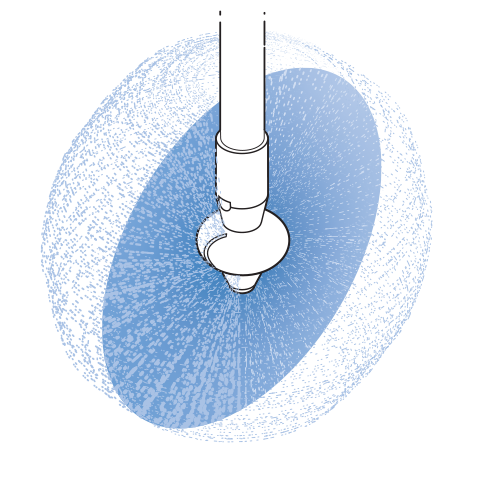
The TWK Series tank washing nozzles are designed specifically for tank interior cleaning. Available in machined stainless steel and all-PTFE (Teflon) construction, they produce a controlled spray pattern that systematically covers the entire interior surface of the tank. For beverage industry CIP applications (food safety standards for CIP systems), the all-PTFE models eliminate any risk of metallic contamination or flavor taint. The TWK Series is available in multiple coverage patterns — 360° for cylindrical tanks, and 270°, 180°patterns for tanks with internal obstructions, asymmetric geometries, or where only partial cleaning is needed. For larger tanks or those with stubborn residues, BEX rotary tank cleaning heads provide higher-impact rotating jets that can remove hardened deposits while using less water than static spray devices.
Controlled humidity is essential in bakeries during proofing (where dough rises before baking) and in the early stages of baking itself. Insufficient humidity during proofing causes the dough surface to dry and form a skin that restricts rising. In the oven, steam injection during the first minutes of baking keeps the crust surface moist and flexible, allowing maximum oven spring (the final burst of dough expansion from gas expansion and yeast activity) before the crust sets.
Why it matters: too little humidity during proofing lets the dough surface dry and skin over, capping how much oven spring it can get — the mist has to add moisture without ever wetting the dough itself.


The JPL Series air atomizing nozzles produce the fine mist (10–50 micrometer droplets) needed for effective humidification without wetting surfaces. The independent air and liquid controls allow precise adjustment of humidity levels. For simpler proofing room humidification systems, the H Series hollow cone nozzles at low flow rates can provide adequate moisture addition.
Baking pans must be coated with release agents (oils or specialized pan sprays) to prevent sticking. This coating must be thin, uniform, and complete — too much release agent wastes material and can affect product flavor; too little results in products sticking and tearing during removal. Solid stream nozzles are used for split-top bread, where a precise line of water must be applied along the top of the dough to create the characteristic split during baking.
Why it matters: too much release agent wastes material and can taint flavor, too little and product sticks and tears coming out of the pan — the coating has to be thin and complete, not just present.


The JPL Series air atomizing nozzles provide the fine, controlled mist ideal for pan release agent application — minimizing overspray and ensuring a thin, even coating. For split-top bread application, the F Series flat fan nozzles in the narrowest spray angle (0° solid stream or 5°) deliver the precise water line needed.
Glazing (applying sugar glaze, egg wash, or other coatings to baked products), frosting application, and conveyor oil spraying (applying a thin film of food-grade oil to conveyor belts to prevent product adhesion) all require precise, uniform spray application to minimize waste and ensure product consistency.
Why it matters: at conveyor speed there's no time to correct an uneven pass — inconsistent coverage shows up directly as wasted coating and inconsistent product straight off the line.
The F Series flat fan nozzles in food-grade stainless steel are the standard for conveyor-width coating applications. For finer coatings where atomization quality matters, the JPL Series air atomizing nozzles provide superior control of coating thickness.
Bottles, cans, kegs, and other containers must be thoroughly washed and rinsed before filling. Bottle washing machines use arrays of nozzles to direct cleaning solutions and rinse water into and over the containers at high speed as they pass through the machine on conveyors.
Why it matters: containers move through these machines at high speed, so incomplete rinsing on even a few passes sends contaminated bottles or cans straight to filling — and a keg's interior geometry around the spear valve leaves nowhere for a weak spray pattern to hide.
The F Series flat fan nozzles and S Series full cone nozzles in small orifice sizes handle the high-speed, precision rinsing needed in bottling lines. For keg washing — which requires thorough cleaning of the keg interior including hard-to-reach areas around the spear valve — the TWK Series keg washing nozzles are purpose-built, available in machined stainless and all-PTFE construction with spray patterns designed to reach every interior surface of a standard keg.
Pasteurized beverages (beer, juice, milk) are heated to a target temperature to kill pathogens and then must be rapidly cooled. Tunnel pasteurizers and cooling sections use spray nozzles to apply cooling water over the containers (bottles or cans) as they pass through on a conveyor. Uniform spray distribution ensures uniform cooling — avoiding thermal shock to glass bottles (which could cause breakage) while still achieving the required cooling rate.
Why it matters: uneven spray distribution here doesn't just cool unevenly — it risks thermal-shocking glass bottles into breaking, so uniform coverage is a safety requirement as much as a quality one.
The S Series full cone nozzles provide the even distribution needed for tunnel pasteurizer cooling sections. Their uniform spray pattern ensures consistent cooling across the full width of the container conveyor.
Conveyors throughout food and beverage plants must be lubricated to reduce friction and prevent container jams. Food-grade lubricant or soapy water is typically sprayed onto the conveyor surface or chain. Disinfection spray systems apply sanitizer to conveyors and food contact surfaces as part of the sanitation program.
Why it matters: over-spray that drifts past the conveyor onto adjacent equipment or product turns a lubrication step into a contamination risk, so containment matters as much as coverage.
The F Series flat fan nozzles in narrow spray angles, oriented to spray along the conveyor surface, provide thin, even lubricant application without over-spraying onto adjacent equipment or products.
Dairy equipment — pasteurizers, separators, homogenizers, filling machines, and piping — must be cleaned and sanitized multiple times daily. Chlorine-based sanitizers are commonly used, and the nozzles must be resistant to the corrosive effects of chlorine solutions.
Why it matters: chlorine-based sanitizers run through these nozzles multiple times a day, so a nozzle that isn't built to resist that corrosion degrades and fails well before its expected service life.
The F Series flat fan nozzles and S Series full cone nozzles in 316 stainless steel handle chlorine sanitizer application. For automated CIP circuits, the TWK Series tank washing nozzles clean process vessels, silos, and storage tanks.
Dairy plants, with their combination of warmth, moisture, and nutrient-rich residues, can attract flying insects. Misting nozzles are used to disperse insecticide or natural pest control compounds in processing and storage areas.
Why it matters: the mist has to stay airborne long enough to actually contact flying insects while keeping both chemical use and surface wetting to a minimum — too coarse a droplet settles out before it does its job.
The JPL Series air atomizing nozzles produce the ultra-fine mist needed for effective insect control — the small droplets remain airborne long enough to contact flying insects, and the low liquid flow rate minimizes chemical usage and surface wetting.
After slaughter, carcasses must be washed to remove blood, bone fragments, and contaminants. The wash must be thorough but must not damage the meat surface or drive contaminants into the tissue. Regulations in many jurisdictions specify the temperature, pressure, and chemical concentration of carcass wash solutions.
Why it matters: regulations specify the exact pressure and chemical concentration for a reason — a wash aggressive enough to damage the meat surface can drive contaminants into the tissue instead of removing them.
The F and FL Series flat fan nozzles at moderate pressures (2–5 bar) provide effective carcass washing without excessive impact. Wide spray angles (65°–80°) ensure full coverage of irregular carcass surfaces.
Brine spraying is used in meat processing for curing and for cooling meat products. Casing moistening (wetting natural or synthetic casings before stuffing) requires a gentle, uniform spray that wets the casing without damaging it.
Why it matters: brine solutions carry dissolved salts and suspended spices that clog a nozzle not built for particle-laden liquids, while casing moistening needs the opposite — a spray gentle enough not to damage the casing it's supposed to protect.
For brine spraying, the YS series nozzles (designed for viscous and particle-laden liquids with large free passage) handle brine solutions that may contain dissolved salts and suspended spices without clogging. The FV Series flat fan nozzles in fine orifice sizes provide the gentle, even spray needed for casing moistening.
Smokehouses accumulate heavy residues of tar, creosote, and smoke condensate that are difficult to remove. High-impact spray nozzles are used for smokehouse cleaning. Liquid smoke — a natural flavoring — is applied by spray nozzles to meat products as an alternative to traditional smoking.
Why it matters: tar and creosote residue in a smokehouse only gets harder to remove the longer it bakes on, and on the flavoring side, uneven liquid smoke application shows up directly as inconsistent flavor from product to product.
For smokehouse cleaning, narrow-angle F Series flat fan nozzles at elevated pressures provide the impact needed to remove baked-on residues. For liquid smoke application, the JPL Series air atomizing nozzles deliver the fine, uniform coating that ensures even flavor distribution.
Meat processing facilities can generate strong odors from rendering, cooking, and waste handling operations. Odor control spray systems atomize masking or neutralizing chemicals into exhaust air streams or ambient air around the facility perimeter.
Why it matters: droplet size is what determines whether the neutralizing chemical actually reaches and reacts with airborne odor compounds — get it wrong and the system is running without controlling much odor.
The JPL Series air atomizing nozzles produce the fine mist needed for effective airborne odor neutralization. Their adjustable air-to-liquid ratio allows operators to optimize droplet size for maximum chemical effectiveness.
All spray nozzles used in food contact or food-zone applications must meet strict material and finish requirements:
| Material | Best for |
|---|---|
| 316 Stainless Steel | The minimum standard for food processing nozzle bodies and internals. Its smooth surface finish resists bacterial adhesion and is easily cleaned. |
| PTFE (Teflon) | Used for tank washing nozzles and applications where metallic contamination or flavor taint must be eliminated. |
| Food-Grade Plastics (Teflon and PVDF) | Used in specific applications where plastic construction is preferred for chemical compatibility or weight considerations. |
All BEX stainless steel nozzles for food service are manufactured to food-grade surface finish standards, ensuring they can be effectively cleaned and sanitized as part of the plant's hygiene program.
The food and beverage industry demands spray nozzles that simultaneously deliver precise application performance and uncompromising food safety compliance. Whether the task is glazing bread, cleaning a fermentation tank, sanitizing a dairy processing line, or applying liquid smoke to sausages — the nozzle selection directly affects product quality, food safety, operational efficiency, and regulatory compliance.
BEX Engineering offers a comprehensive range of food-grade spray nozzles and tank cleaning equipment designed for the unique demands of food and beverage processing. Contact BEX Engineering to discuss your specific food industry spray nozzle requirements.