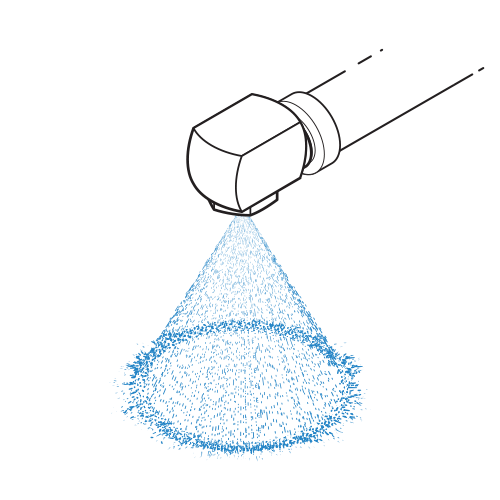
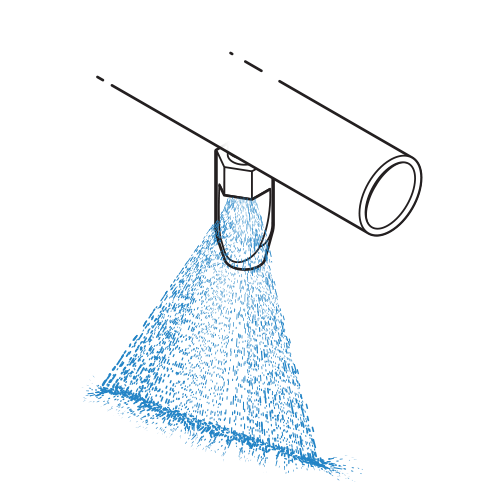
The energy industry — spanning coal-fired and gas-fired power generation, natural gas processing, petroleum refining, nuclear cooling, and renewable energy operations — is one of the largest users of industrial spray nozzle technology. Every stage of fossil fuel power generation involves spray: water is sprayed to suppress coal dust at the fuel yard, fine mist is injected into gas turbine inlets to recover lost megawatts, hot flue gas is quenched before it reaches pollution control equipment, limestone slurry is distributed through scrubber towers to remove Sulphur dioxide, and emissions are washed before being released to atmosphere. In each of these applications, the spray nozzle is not a passive fitting but an engineered component whose selection — pattern, flow rate, droplet size, and material — directly determines whether the system meets its performance, environmental, and safety objectives. In this article, we examine the five key spray nozzle applications in the energy industry and identify the BEX Engineering products best suited to each.
Coal-fired power plants handle thousands of tonnes of coal per day, and coal dust is generated at every point where material is moved, dropped, or crushed. The EPA, OSHA, and MSHA have all imposed regulations on facilities that handle coal, regulations designed to protect workers and the environment from fugitive coal dust emissions. The consequences of inadequate dust control go beyond regulatory compliance: coal dust is combustible, and at sufficient concentrations it is explosive. The brittle nature of coal, especially subbituminous coal, makes dust very difficult to control, and the hazard escalates because the conveyed product is also flammable and may reach explosive concentrations in enclosed transfer houses and conveyor galleries.
Dust generation is most intense at transfer points — wherever coal falls from one conveyor to the next, drops into a crusher, or is discharged into a storage silo. Fugitive emissions from these drop points can be limited by restricting the drop height, partial enclosures, or telescopic chutes, but water spray suppression is also widely used as the primary or supplementary control method. Nozzles at transfer points must produce droplets in the 50–200 micrometer range — airborne water droplets and dust particles attract most readily when they are approximately the same size. Droplets that are too large pass between fine particles without contact; droplets that are too small are carried away in the dust-laden airstream without impacting the coal.
Why it matters: coal dust is combustible, and in an enclosed transfer house or conveyor gallery it can reach explosive concentrations — dust knocked down at the drop point never gets the chance to build up there.
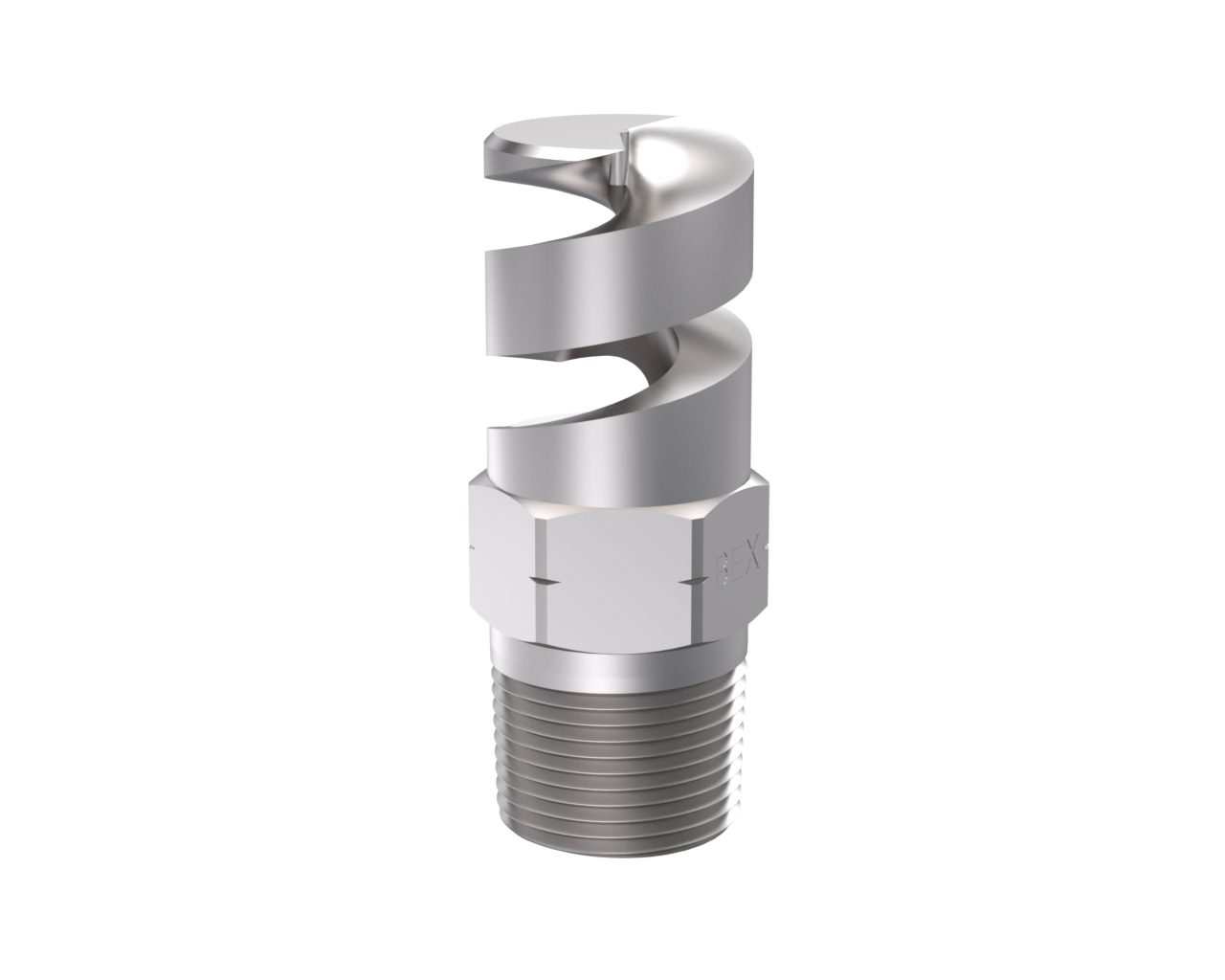
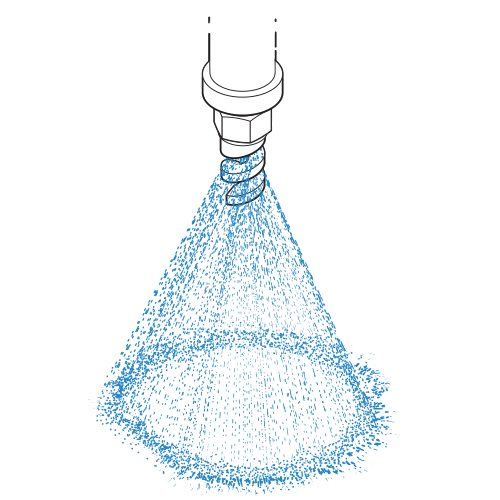
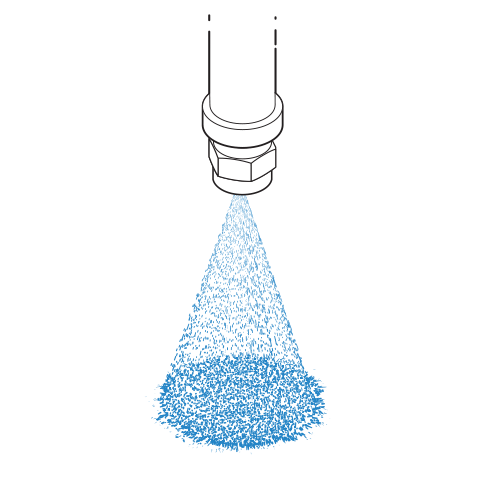
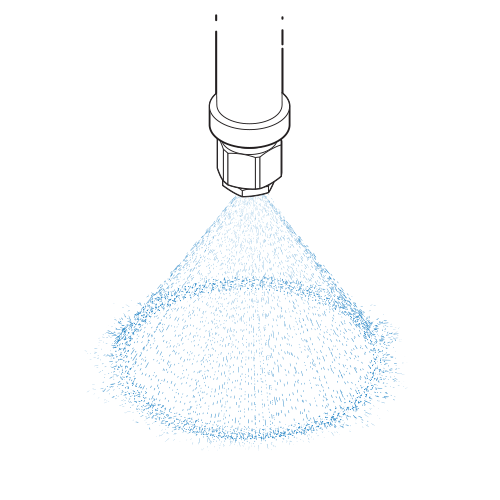
The BEX C Series hollow cone nozzles produce the fine droplet spectrum (100–300 micrometers VMD at standard pressures) ideal for transfer point dust suppression — fine enough to intercept airborne coal particles and heavy enough to fall through the dust cloud under their own momentum rather than being swept away. For the highest-dust-load positions, such as crusher discharge points and bin loading chutes, the YS and YH Series spiral (Twister) nozzles offer a crucial advantage: their open spiral design has no internal vanes or precision orifices to clog in the dirty, often recycled water supplies used in coal yard dust suppression systems. Their full cone spray pattern with a range of droplet sizes makes them particularly effective at capturing both the coarse and fine particle fractions that are generated simultaneously at crush and transfer points.
Open coal stockpiles are a continuous source of fugitive dust, particularly during dry, windy conditions. The goal of moisture addition to stockpile surfaces is to raise the coal surface moisture content to an optimal level, typically around 6–8% — enough to bind surface particles together and prevent wind lift-off, but not so much as to create handling problems in conveyors or increase the risk of spontaneous combustion in high-volatile coal types. Fixed spray systems on risers around the pile perimeter, or water trucks equipped with spray bars making periodic passes over the pile surface, are the standard approaches. The spray must penetrate the outer surface rather than merely wetting it, since a surface layer that dries within minutes in warm, sunny conditions provides no lasting protection.
Why it matters: too little water and the pile sheds dust every time the wind picks up, too much and the coal causes handling problems in the conveyors — the moisture target is narrow, and even coverage is how you hit it.
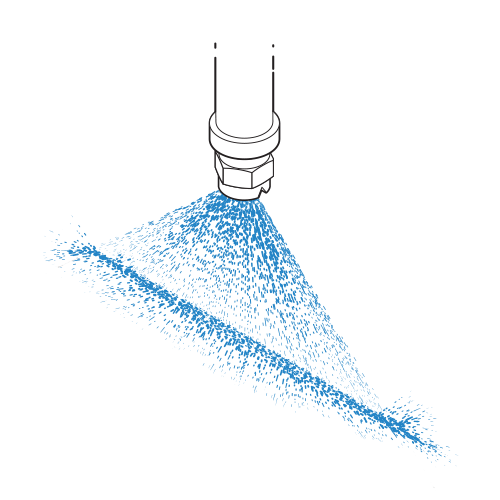
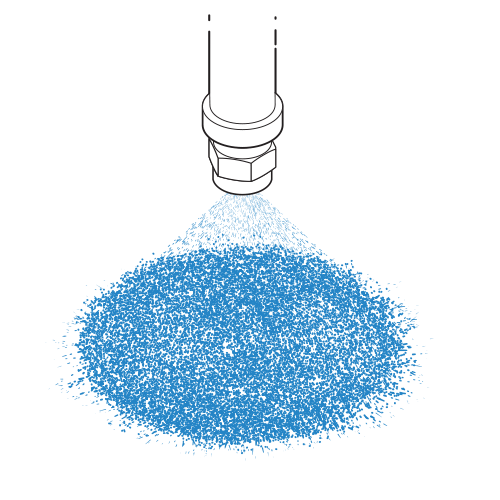
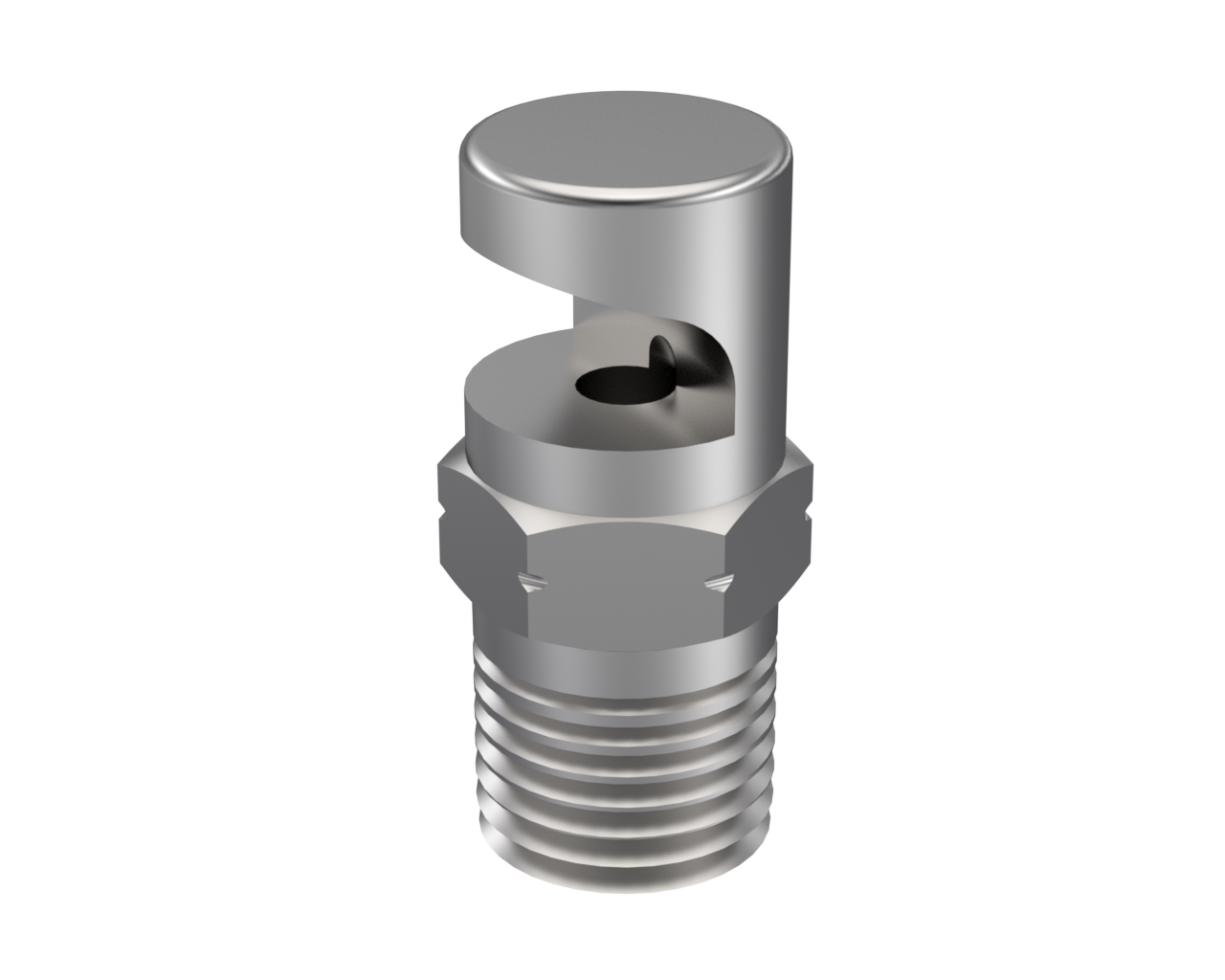
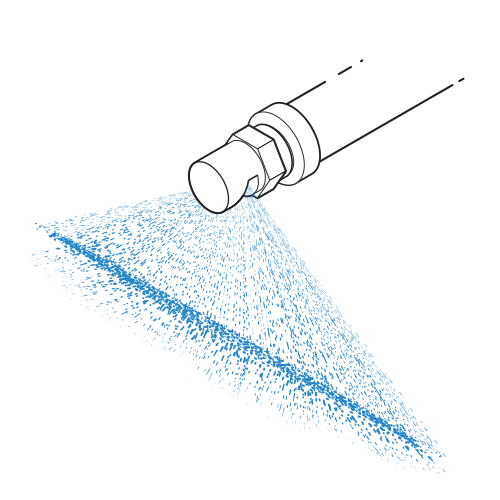
Wide-angle F Series flat fan nozzles (80°–110°) and S Series full cone nozzles provide the broad, penetrating coverage needed for stockpile surface wetting from fixed risers or truck-mounted spray bars. For large open stockpiles where coverage must extend beyond what fixed risers can reach, the SW Series wide-angle full cone nozzles maximize the spray radius from each nozzle position, reducing the number of supply risers required. The FL Series deflector-type flat fan nozzles are a practical choice for water truck spray bars because their open deflector design tolerates the dirty, sediment-containing water typical of coal yard reclaim ponds without clogging.
Gas turbines are constant-volume machines: their power output and thermal efficiency are directly proportional to the density — and therefore the temperature — of the air entering the compressor. Gas turbine output and efficiency are known to decrease as ambient temperature increases. On hot summer days, when electricity demand peaks and ambient temperatures are highest, a gas turbine may be producing 15–25% less power than its ISO-rated output at 15°C. Inlet air cooling is the most cost-effective method of recovering this lost capacity without capital investment in additional generating units.
High-pressure fogging — injecting ultra-fine water droplets directly into the turbine inlet air stream — is the most effective evaporative cooling method available. Unlike conventional media-type evaporative cooling, fogging can achieve 100% saturation of the inlet air so that its temperature can be reduced to the wet-bulb temperature, whereas media coolers can only achieve 80–85% of the wet-bulb depression. Fog cooling can increase gas turbine output by 10–18% for every 10°C decrease in inlet air temperature, and fogging systems impose a negligible pressure drop on the inlet airflow compared to media coolers, preserving the turbine’s aerodynamic efficiency.
The engineering requirement for gas turbine inlet fogging is demanding: the droplets must be small enough to evaporate completely before the air reaches the compressor inlet face — original equipment manufacturers have strict guidelines for cooling below the dew point due to icing concerns, and ice forming at the compressor inlet can cause serious blade damage. This requires droplets in the 10–20 micrometer range, which demands high-pressure, precision-atomizing nozzles rather than conventional hydraulic spray nozzles.
Why it matters: the hottest afternoons are when demand and power prices peak and when the turbine is producing least, so every degree taken off the inlet air is capacity recovered when it's worth the most.
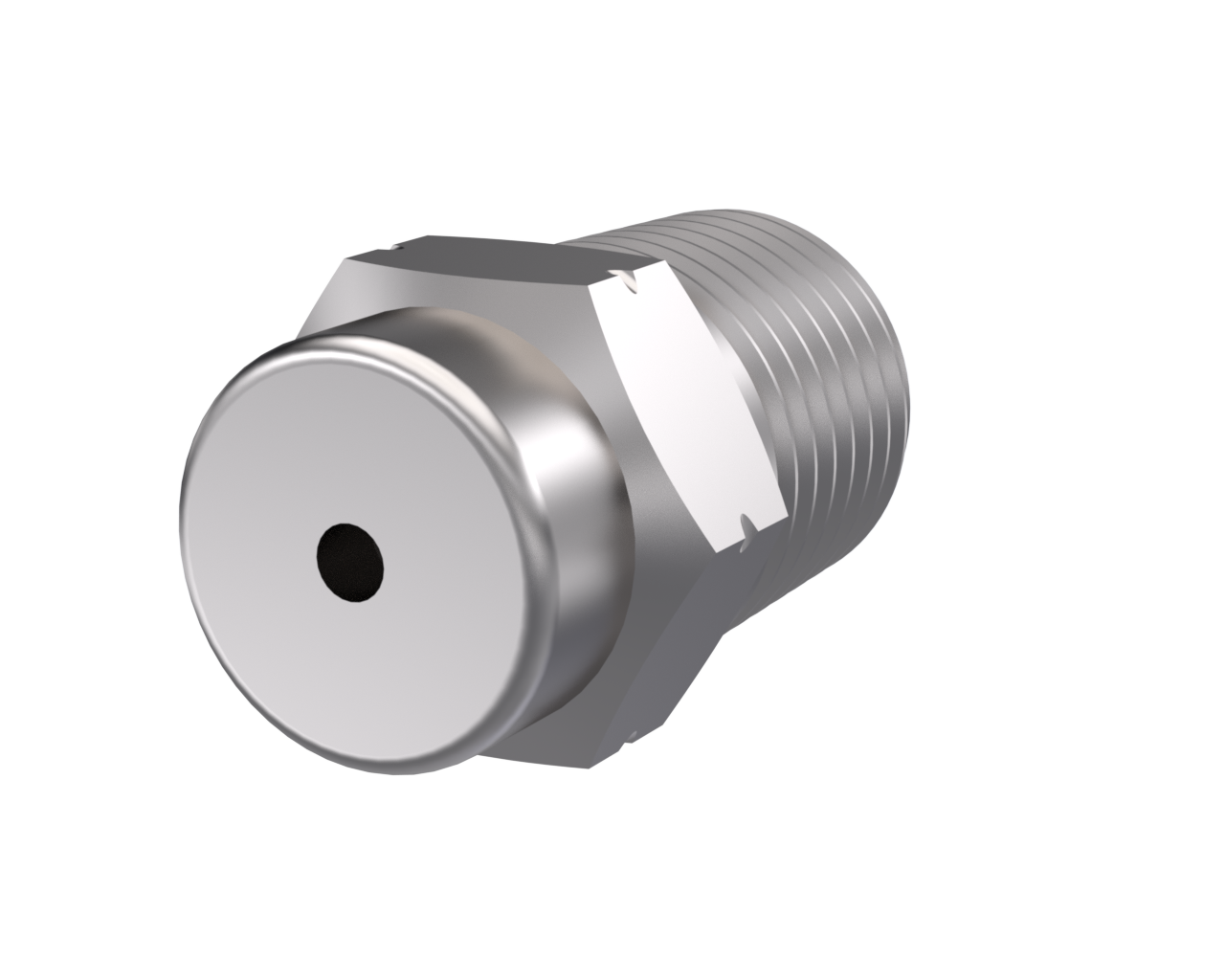
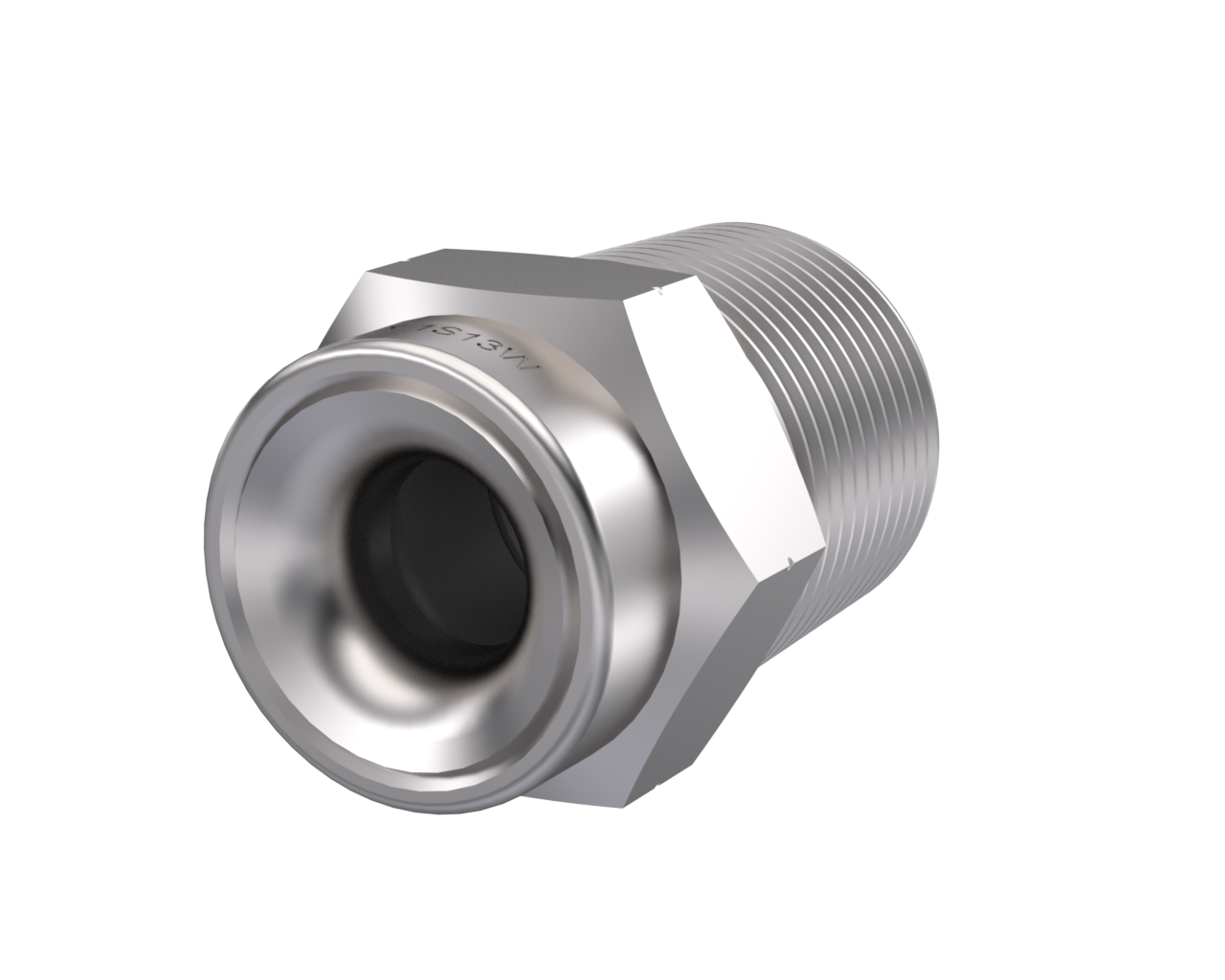
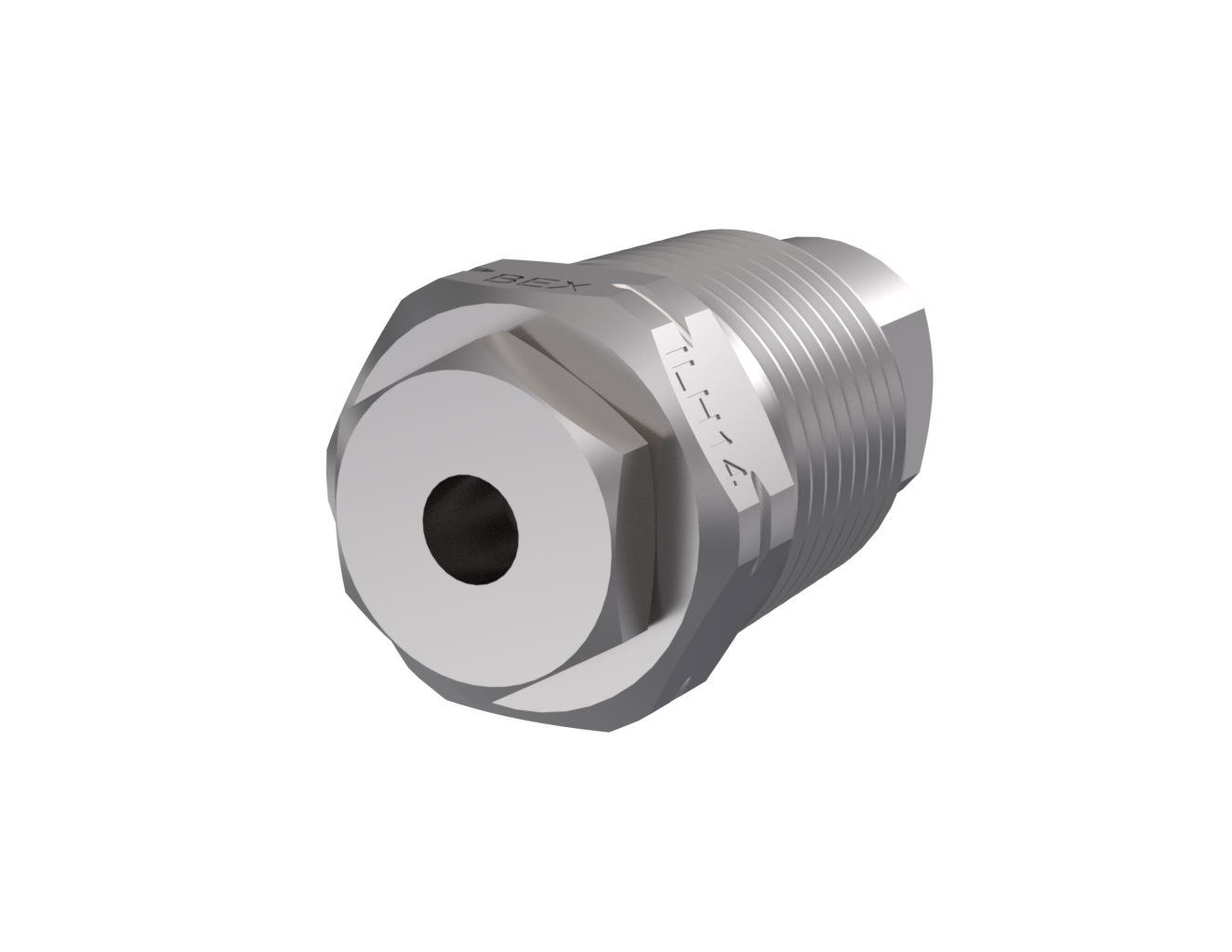
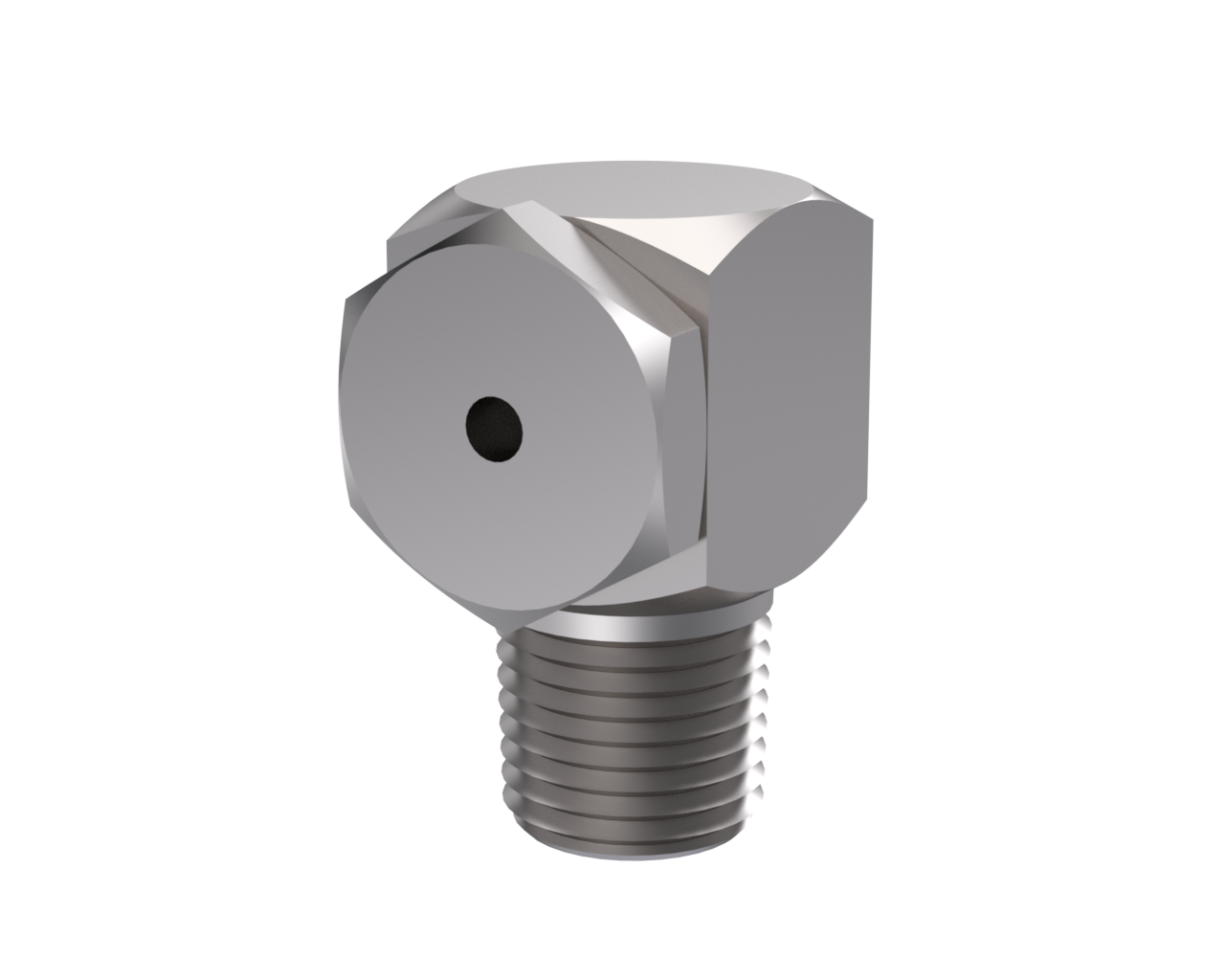
Gas turbine output drops in hot weather, because warm air is less dense and reduces the mass flow through the compressor. Inlet air cooling fixes this by evaporating water into the intake air to lower its temperature. BEX's ILH series in-line hollow cone nozzles are well suited to delivering that water. They produce a very evenly distributed hollow cone spray through the center axis of the nozzle body, so water is spread uniformly across the inlet and the air is cooled without hot or wet spots. Operators can tune droplet size with pressure: lower pressures give medium, uniform droplets, and higher pressures give finer droplets that evaporate faster. The range runs from 5 to 100 psi, with flows from about 0.17 to 35 USGPM. The nozzles have large free passages that reduce clogging and interchangeable caps for easy cleaning, which keeps downtime low in continuous service. They come in brass, 303 stainless steel and 316 stainless steel, including corrosion-resistant options that hold up to demineralized water. Pipe sizes run from 3/8" to 1-1/2", which makes them easy to fit into manifold arrays across large inlet ducts.
Steam cycle power plants — whether coal-fired, gas-fired combined cycle, or nuclear — require large quantities of cooling water to condense steam after it has passed through the turbines. Where once-through river or seawater cooling is not available or permitted, cooling towers evaporate water to reject heat to the atmosphere. Pre-cooling the air entering a dry or hybrid cooling tower — or supplementing a wet cooling tower during high ambient temperature conditions — using fine water mist can meaningfully improve condenser back-pressure and therefore plant efficiency during peak summer conditions.
Why it matters: condenser back-pressure drives plant efficiency, so pre-cooling pays off on peak days — but droplets that reach the fill or the aluminum fins of an air-cooled condenser cause scaling and corrosion instead.
The BEX H Series hollow cone nozzles at low operating pressures produce the fine, evaporative mist needed for cooling tower inlet air pre-cooling without wetting the tower fill or structure. For air-cooled condenser (ACC) pre-cooling, where water must be directed into the hot inlet air without wetting the aluminum fin surfaces that would cause corrosion, the JPL Series air atomizing nozzles produce the finer droplet distribution needed to ensure complete evaporation before droplets reach any fin surface. All nozzles for power plant cooling tower and condenser applications should be specified in 316 stainless steel for resistance to the treated water chemistry and the continuous outdoor weathering conditions. C Series hollow cone nozzles can also be used at higher pressures (3 bar +).
Hot flue gas from power plant boilers, waste-to-energy incinerators, and industrial process furnaces must be conditioned — primarily cooled — before it can be processed by downstream pollution control equipment. Baghouses (fabric filter dust collectors), electrostatic precipitators, and wet scrubbers all have maximum inlet temperature limits that, if exceeded, cause equipment damage: filter bags melt or shrink, electrostatic precipitator electrode geometry distorts, and scrubber components suffer thermal shock. A quench tower or hot gas quench system is often the first step in conditioning a high-temperature and polluted air stream so that particulate, acid gases, metals, and other emissions can be appropriately removed. The cooling mechanism is entirely evaporative: water is atomized into the hot gas stream and absorbs latent heat as it evaporates, reducing the gas temperature while simultaneously reducing gas volume — which reduces the size and operating cost of all downstream equipment.
Nozzle selection is the most critical engineering decision in a gas cooling system. The droplets must be small enough to evaporate fully before reaching the vessel wall — wall wetting causes acid corrosion and solids deposition that can block the vessel and create serious operational problems. At the same time, the droplets must carry sufficient momentum to penetrate to the center of large-diameter duct or vessel cross-sections, ensuring uniform temperature reduction across the full gas flow area. Recycled process water — the most common water supply in power plant gas cooling systems — typically contains dissolved solids and suspended particulate that rapidly clog conventional nozzle designs.
Coal-fired boiler flue gas leaves the economizer at temperatures of 300–450°C and must be cooled to below 200°C (and often to 120–150°C) before entering the baghouse or electrostatic precipitator. In plants fitted with wet FGD systems downstream, the gas may first pass through a gas conditioning tower (GCT) to reduce temperature and adjust humidity before the scrubber. The GCT receives the hottest, dirtiest gas in the entire flue gas treatment train, and the nozzles inside it are exposed to high-temperature, abrasive, and often corrosive conditions throughout their service life.
Why it matters: gas that reaches a baghouse or precipitator above its temperature limit melts bags or distorts electrodes, while droplets that hit the tower wall cause acid corrosion and deposits that block the vessel.
The BEX YH and YS Series spiral (Twister) nozzles are the standard choice for gas conditioning towers and boiler flue gas cooling applications. Their open spiral design has no internal vanes or precision orifices — the features of conventional full cone nozzles that erode and clog rapidly in high-temperature, particle-laden environments — and they produce a full cone spray pattern with a broad droplet size distribution that promotes rapid evaporative cooling throughout the gas cross-section. For GCTs where the finest possible droplets are needed to achieve complete evaporation within a short vessel height, the JPL Series air atomizing nozzles using twin-fluid atomization produce droplets in the 10–50 μm range, maximizing the evaporative surface area per unit of water injected. All nozzles for gas conditioning service should be specified in 316 stainless steel or Hastelloy C-276 where the flue gas contains significant concentrations of Sulphur dioxide or hydrochloric acid.
Waste-to-energy (WtE) incinerators and industrial boilers firing high-Sulphur or chlorine-containing fuels generate flue gases that are both hotter and more corrosive than conventional coal boiler flue gas. Quench temperatures of 850–1,000°C must be reduced to below 200°C in the shortest possible vessel height to prevent re-synthesis of dioxins and furans in the 200–450°C temperature window. The spray nozzle serves as the core intensification component of the quench tower, its atomization characteristics directly determining the gas–liquid interfacial area and evaporation timescale. In these highly corrosive environments, nozzle material selection is as critical as droplet size and coverage pattern.
Why it matters: quench too slowly and the gas lingers in the temperature window where dioxins and furans re-form — a compliance problem that no downstream equipment can undo.
For WtE and high-temperature quench applications, the BEX JPL Series air atomizing nozzles in Hastelloy C-276 provide the ultra-fine droplet distribution needed for rapid quenching within a compact vessel, combined with the chemical resistance required for continuous exposure to HCl, SO₂, and the condensed acid phases that form during cooling. Multiple nozzle layers installed at different heights in the quench vessel provide staged cooling and ensure complete coverage of the gas cross-section regardless of flow rate variation.
Power station emissions contain a complex mixture of pollutants — Sulphur dioxide from fuel Sulphur, nitrogen oxides from high-temperature combustion, particulate matter, and trace metals including mercury. Wet scrubbing systems use spray nozzles to bring liquid — water, alkaline reagent solutions, or reagent slurries — into intimate contact with the flue gas, transferring the target pollutants from the gas phase into the liquid phase for subsequent treatment and disposal. The effectiveness of the scrubbing process depends directly on the quality of gas-liquid contact, which is determined by the spray pattern, droplet size, and distribution uniformity produced by the nozzle.
In plants without dry electrostatic precipitators, or as a supplementary particulate control measure downstream of a primary ESP, wet scrubbers capture fly ash and residual particulate from the flue gas stream. The scrubbing liquid must be distributed uniformly across the full duct or vessel cross-section — any areas of poor coverage allow gas to bypass without treatment, reducing overall collection efficiency. The effectiveness of wet scrubber performance depends directly on the liquid flow rate and the uniformity of gas-liquid contact, both of which are direct functions of nozzle performance. As scrubber water is recirculated, it accumulates dissolved ash, fly-ash particles, and reaction products that present a severe clogging hazard to conventional nozzle designs.
Why it matters: any section of the duct with poor spray coverage lets gas through untreated, and in recirculated scrubber water a nozzle starting to clog quietly opens exactly that kind of gap.
The BEX YS Series spiral (Twister) nozzles are the primary choice for fly ash scrubbing applications. Their open spiral flow path has no internal vanes, small orifices, or precision passages that clog in recirculated scrubber water containing dissolved solids and suspended ash. They produce a full cone spray pattern with a range of droplet sizes that optimises the collision probability between water droplets and fly ash particles across the particle size spectrum. For packed tower scrubbers where liquid must be distributed uniformly over the packing surface, the S Series full cone nozzles provide the symmetrical, even spray pattern that distributor design requires. All nozzles for fly ash scrubbing service should be specified in 316 stainless steel as the minimum, with Hastelloy C-276 specified where the scrubber water pH is consistently below 4 or where chloride concentrations are elevated.
Natural draught and mechanical draught cooling towers generate a visible water vapour plume that, in certain atmospheric conditions, can deposit as drift on surrounding areas. Drift eliminators reduce but do not eliminate this; in some plants, spray systems in the cooling tower basin recirculate blowdown water through the tower to manage the water chemistry. Gas washing of cooling tower exhaust is an increasingly specified measure at plants with stringent environmental permits, particularly those near sensitive receptors.
Why it matters: blowdown and drift management is a permit issue for plants near sensitive neighbours, and predictable flow is what lets the system be sized to hit its water-turnover target.
The BEX S Series full cone nozzles in corrosion-resistant 316 stainless steel or PVDF provide the uniform, metered water distribution needed for cooling tower basin and blowdown management applications. Their predictable flow rates at operating pressure allow system designers to accurately size recirculation pumps and pipework for the required water turnover rate.
Environmental legislation governing power plant emissions has become progressively more stringent over the past three decades. The EPA’s Clean Air Act regulations, NESHAP standards for hazardous air pollutants, and the Mercury and Air Toxics Standards (MATS) collectively require power plants to control sulphur dioxide, nitrogen oxides, particulate matter, mercury, and acid gases to levels that in many cases demand state-of-the-art pollution control technology. Spray nozzles are at the heart of the wet scrubbing systems that achieve compliance.
Flue gas desulphurisation is the largest and most technically demanding spray application in a coal-fired power plant. For a typical coal-fired power station, FGD systems using wet scrubbing can remove 90% or more of the SO₂ in the flue gases. The dominant technology is the open-tower wet FGD process, in which an alkaline sorbent slurry — typically limestone — is sprayed into the absorber tower and contacts the flue gas flowing upward in countercurrent. The SO₂ reacts with the calcium carbonate in the limestone to form calcium sulphite, which is oxidised to calcium sulphate (gypsum) in forced-oxidation systems. The nozzles in an FGD absorber must distribute the limestone slurry uniformly across the full tower cross-section at multiple spray levels, ensuring that the rising gas contacts a dense curtain of reagent droplets throughout its residence time in the absorber. The FGD process requires SO₂ removal efficiency to be maintained above 95% at varying load conditions, placing a premium on consistent nozzle performance over a service life measured in years.
FGD nozzles operate in one of the most hostile environments encountered in industrial spray applications: a continuous flow of hot, wet, SO₂-laden flue gas, with recirculated slurry containing 10–20% suspended calcium carbonate and calcium sulphate solids. Conventional full cone nozzles with internal vanes and precision orifices erode rapidly in abrasive slurry service and clog progressively as solids accumulate in internal passages. Nozzle failure reduces coverage uniformity, reducing SO₂ removal efficiency and risking permit exceedances.
Why it matters: removal efficiency has to stay above 95% for years of service, and a single eroded or plugged nozzle leaves a coverage gap that shows up directly as SO₂ at the stack and risks a permit exceedance.
The BEX YS Series spiral (Twister) nozzles are the defining product for FGD absorber service. Their one-piece spiral design has no internal vanes, cores, or small passages — the entire flow path is an open spiral channel that the limestone slurry passes through without restriction. This design is inherently resistant to clogging and erosion, the two primary failure modes for nozzles in FGD service. The YS Series produces a full cone spray pattern with a range of droplet sizes well matched to FGD absorber performance requirements: fine droplets provide large interfacial area for SO₂ absorption, while larger droplets ensure adequate penetration to the centre of large-diameter towers. Available in pipe sizes from 1/4” to 1-1/2” NPT in 316 stainless steel, Hastelloy C-276, PVDF, and other corrosion-resistant materials, the YS Series is specified for both spray headers and individual nozzle positions throughout the absorber.
Where capital cost constraints or smaller plant sizes preclude a full wet FGD system, dry injection systems inject lime or sodium bicarbonate directly into the flue gas duct, and spray dry systems inject atomised lime slurry into a separate spray dry absorber vessel. In spray dry absorption, the atomisation of the lime slurry is the critical step: the droplet size determines both the reagent surface area available for SO₂ reaction and whether the droplets dry completely before reaching the vessel wall or downstream particulate collector. Insufficiently atomised droplets leave wet spots in baghouses that cause bag blinding and create handling problems with the collected solids.
Why it matters: slurry droplets that don't dry before reaching the wall or the baghouse leave wet spots that blind filter bags and turn the collected solids into a handling problem.
The BEX JPL Series air atomizing nozzles provide the fine, controlled atomisation required for spray dry absorption systems, producing droplets in the 10–50 μm range that maximise reagent surface area while ensuring complete evaporation within the vessel residence time. Their construction options provide the chemical resistance needed for lime slurry service in the acidic gas environment of an SO₂-laden flue gas stream.
Wet FGD absorbers and other wet scrubbing systems are fitted with mist eliminators — arrays of chevron or wave-profile baffles — that capture entrained liquid droplets before the cleaned gas exits the absorber. Over time, these eliminators accumulate deposits of calcium sulphate scale, fly ash, and other solids that progressively increase pressure drop and reduce gas throughput. Periodic wash-down with high-pressure water spray is essential to maintaining mist eliminator performance and preventing blinding that would force the plant to reduce load or shut down for mechanical cleaning.
Why it matters: a mist eliminator that blinds with scale raises pressure drop until the plant has to cut load or shut down for mechanical cleaning — regular, effective wash-down is what keeps it online.
The BEX F Series flat fan nozzles arranged in wash headers positioned to direct spray across the face of each mist eliminator section provide the targeted, high-impact cleaning needed to dislodge scale deposits and restore pressure drop to design values. Their narrow spray angle variants concentrate the cleaning force onto the eliminator surface from the available standoff distance, and their 316 stainless steel construction withstands the corrosive wash water chemistry in the absorber environment. The FP Series flat fan nozzles can also be used if higher impact is required.
The energy industry presents some of the widest range of corrosive service conditions encountered in any industrial sector. The combination of high temperatures, acidic gas environments, abrasive particulate, and highly corrosive reagent slurries demands careful material selection matched to the specific chemistry and temperature of each application:
| Material | Best for |
|---|---|
| 316 Stainless Steel | The baseline specification for most energy industry spray applications, including gas turbine inlet fogging, coal dust suppression, cooling tower systems, and FGD mist eliminator wash-down. Adequate corrosion resistance to the chemistries typically encountered at near-neutral pH and moderate temperatures. |
| Hastelloy C-276 | Required for FGD absorber nozzles handling limestone or lime slurry in contact with SO₂-containing flue gas, for gas quench nozzles where condensing HCl or H₂SO₄ is present, and for WtE quench systems handling HCl-containing flue gas. The standard specification for any energy industry application where pH is consistently below 3 or where chloride concentrations exceed 500 ppm. |
| PVDF (Polyvinylidene Fluoride) | An excellent alternative to Hastelloy C-276 in applications where polymeric construction is acceptable, providing superior resistance to hydrofluoric acid and mixed acid environments at temperatures up to approximately 120°C. Commonly specified for FGD spray dry absorbers and HF scrubbers in petroleum refinery energy systems. |
| YS Series spiral design — any material | The defining specification for any application involving recirculated process water, abrasive slurries, or liquids with a tendency to deposit scale or suspended solids. The open spiral design reduces clogging and wear failure modes that determine service life in FGD, gas washing, and coal yard spray systems. Material is selected to match the specific corrosive environment; 316SS for general service, Hastelloy C-276 for acid gas service. |
In the energy industry, spray nozzles are not support equipment — they are integral to core plant performance. The gas turbine inlet fogging system that recovers 15% lost megawatts on a hot summer afternoon is delivering revenue directly. The FGD absorber nozzles that maintain 95% SO₂ removal are keeping the plant in compliance with its operating permit. The gas conditioning tower nozzles that protect the downstream baghouse from overtemperature are preventing a catastrophic equipment failure. In every case, the right nozzle selection — the correct pattern, droplet size, flow rate, and material for the specific application — is what makes the system perform as designed throughout its service life.
BEX Engineering manufactures the full range of spray nozzle solutions required for energy industry applications, with the materials and configurations to handle virtually any combination of temperature, corrosivity, and abrasion encountered in power generation and energy production. Contact BEX Engineering to discuss your specific application requirements.
For assistance selecting the right nozzle for your energy industry application, contact BEX Engineering today.