Dairy processing is one of the most regulated and technically demanding environments in food manufacturing. From the moment raw milk arrives at the receiving dock to the moment finished product leaves in a refrigerated truck, every step of the process is governed by strict sanitation requirements, precise temperature and humidity controls, and validated cleaning protocols. Spray nozzles are integral to all of it — atomising concentrates in spray dryers, maintaining humidity in cheese caves and cold stores, drying bottles and cartons before labelling, applying coatings to filled containers, cleaning tanks and silos between every production run, and sanitising the surfaces that contact milk at every stage. In this article, we examine the four key spray nozzle applications in dairy processing and identify the BEX Engineering products best suited to each.
Dairy plants perform a wide variety of liquid spray operations directly on products and containers — applying functional coatings to finished products, rinsing containers before filling, lubricating conveyors, and precisely dosing liquid ingredients into products. Each application has specific requirements for spray pattern, flow rate, droplet size, and materials of construction, all within a regulatory framework that mandates food-grade surfaces and validated cleaning.
Tunnel pasteurizers for packaged dairy products — bottled milk, flavoured milk, UHT cartons, and yogurt cups — heat products to the pasteurization temperature and then rapidly cool them before labelling and secondary packaging. Spray nozzles in the cooling section apply chilled water over the containers as they travel on a conveyor, reducing their temperature uniformly and at a controlled rate. Uniform distribution is essential: uneven cooling causes thermal gradients that stress glass containers and can produce texture defects in gel-set products like yogurt and desserts.
Why it matters: a strip of containers that cools slower or faster than its neighbours can crack glass or leave yogurt and desserts with texture defects — and on a pasteurizer, every container on that strip is affected.
The BEX S Series full cone nozzles provide the symmetrical, even coverage needed in tunnel pasteurizer cooling sections, ensuring consistent temperature reduction across the full width of the container conveyor regardless of container geometry. Their uniform full cone pattern eliminates the hot strips and cold strips that result from flat fan or hollow cone nozzles in this application. For hot water pasteurizer sections where water temperature is elevated, all nozzles should be specified in 316 stainless steel to resist the combination of elevated temperature and any cleaning chemical carryover.
Plastic bottles, glass bottles, HDPE jugs, and gable-top cartons must be rinsed immediately before filling to remove any dust, mold spores, or particulates that accumulated during storage or transit. Container rinsing in dairy plants is performed at high speed — matched to the filling line speed, which can be hundreds of containers per minute on high-capacity lines. The nozzle must deliver a thorough internal rinse in the fraction of a second the container is inverted over the rinse station, using the minimum water volume consistent with effective cleaning.
Why it matters: at hundreds of containers per minute, each bottle gets a fraction of a second under the rinse — a nozzle that under-delivers means containers going to the filler with the dust or spores the rinse was there to remove.
The BEX F Series flat fan nozzles and S Series full cone nozzles in small orifice sizes handle the high-speed, precision rinsing required in dairy container filling lines. Their predictable flow rates at a given pressure allow the system engineer to calculate the exact rinse volume delivered per container at line speed, and to verify compliance with the minimum rinse volume specified in the plant’s hygiene program. All nozzles for container rinsing must be specified in 316 stainless steel to meet the material requirements of the 3-A Sanitary Standards that govern equipment construction in Grade A dairy plants.
Conveyors throughout a dairy plant — from the filling line to the labeler, case packer, and cold store conveyor — must be lubricated continuously to prevent containers from jamming, reduce wear on plastic conveyor components, and ensure smooth product flow at line speed. Food-grade conveyor lubricant is applied by spray nozzle to the chain or belt surface, typically as a dilute foam or water-based solution. The application must be thin, uniform, and precisely metered: excess lubricant causes containers to tip and fall on high-speed lines; insufficient lubricant allows metal-to-metal contact that generates particles and noise.
Many dairy products also receive a surface coating after filling — particularly wax coatings on aged cheeses (which prevent moisture loss and mold growth during maturation) and oil coatings on semi-hard cheese blocks (which preserve the rind during storage). These coatings must be applied uniformly, at the correct rate, and without creating runs, pooling, or uncovered areas that would leave the product unprotected.
Why it matters: too much lubricant tips containers over on a high-speed line and too little causes wear and jams, while a gap in a cheese coating leaves the rind open to moisture loss and mould for the whole ageing period.
The BEX F Series flat fan nozzles in narrow spray angles, directed along the conveyor surface or chain, apply a thin, even film of food-grade lubricant without over-spraying onto adjacent product or equipment surfaces. For cheese wax and oil coating, the F Series flat fan nozzles oriented to cover the full product face provide the metered, uniform film application needed to achieve complete coverage at minimal coating weight. Where the coating is viscous or the product geometry requires wrap-around coverage from a single nozzle, the S Series full cone nozzles provide the broader, more three-dimensional pattern needed to coat irregular product shapes from a single spray head position.
Tank and vessel cleaning is arguably the most critical spray application in dairy processing. The FDA’s Grade "A" Pasteurized Milk Ordinance (PMO) mandates that all milk-contact surfaces be properly cleaned and sanitized, and specifically that farm bulk milk tanks must be emptied at least every 72 hours and cleaned each time they are emptied. Beyond farm tanks, every silo, balance tank, pasteurizer surge tank, blend tank, fermentation vessel, cream separator bowl, and CIP holding vessel in a processing plant must be cleaned on a validated schedule. The consequences of inadequate cleaning are measurable and direct: the PMO sets a Standard Plate Count limit of 20,000 CFU/mL for pasteurized milk, and consistent readings trending toward this threshold are a direct indicator of a cleaning problem.
Dairy soils — milk fats, proteins, and sugars — are among the most challenging in any food industry. Milk fat deposits require alkaline detergent at elevated temperature to emulsify and remove; milk protein (especially heat-denatured whey protein from pasteurizers) forms tenacious films that require both chemical action and mechanical impingement to dislodge; milk sugar (lactose) and calcium phosphate scale require acid cleaning to dissolve. CIP systems use hot chemical solutions at specific temperatures to eliminate bacterial biofilms from pipelines, tanks, and pasteurization equipment, with a typical dairy CIP cycle comprising an alkaline wash (1–2% caustic soda, 70–80°C), intermediate water rinse, acid wash (0.5–1% nitric or phosphoric acid), and a final sanitizer rinse. The nozzle must deliver adequate mechanical impingement to all interior surfaces throughout each of these stages.
Vertical cylindrical silos of 50,000 to 500,000 litres are the primary raw milk storage vessels in large dairy plants. Their tall aspect ratio and large diameter make thorough CIP challenging: the spray from a single centrally mounted nozzle must reach every part of the wall surface, including the curved lower cone, the straight cylindrical wall, and the underside of the top dome. Static spray balls are adequate for rinsing but insufficient for removing the protein films that build up on raw milk silos over time. Rotating tank washers with higher impingement are increasingly specified for silo CIP as regulatory scrutiny of cleaning validation intensifies.
Why it matters: protein film left on a silo wall becomes a home for biofilm that re-contaminates every load of raw milk that follows, and it shows up as plate counts trending the wrong way.
The BEX TWK Series rotating tank washing nozzles are purpose-designed for this application. Their rotating solid-stream jets deliver significantly higher impingement force at the tank wall than static spray balls at the same supply flow rate, removing protein deposits and biofilm that low-impingement devices leave behind. Available in 316 stainless steel and all-PTFE (Teflon) construction with NPT threaded and sanitary tri-clamp connections, the TWK Series is available in 360°, 270°, and 180° coverage patterns to suit the internal geometry of each vessel, including those with agitator shafts, baffles, internal ladders, or heating coils that obstruct full 360° coverage.
Pasteurizers are the most critical equipment in a Grade A dairy plant from a food safety perspective. The PMO requires documented evidence that HTST pasteurizers maintain validated time-temperature parameters during every production run, and CIP systems should undergo full revalidation at minimum annually and after any modification to CIP-able equipment. The surge tanks and balance tanks associated with pasteurization systems, along with downstream holding tanks, blend tanks, and standardization vessels, all require the same rigorous CIP regime as the pasteurizer itself. For these smaller-volume, complex-geometry vessels — many of which include agitator assemblies, multi-port connections, and heating jackets — compact, high-impingement CIP nozzles provide thorough cleaning without the complexity of a rotating assembly.
Why it matters: the vessels around a pasteurizer sit right at the heart of the plant's food safety system, so a cleaning shadow behind an agitator or port can undo the protection pasteurization provides.
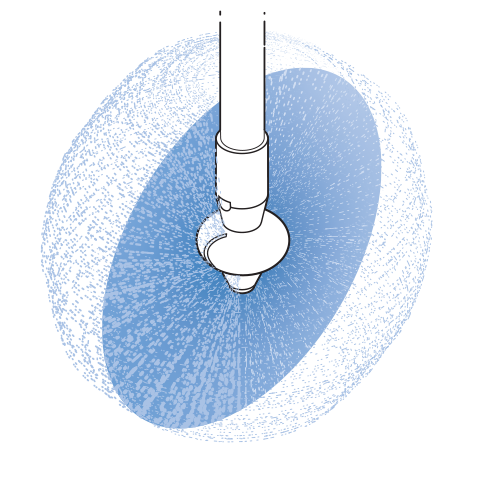
The BEX SN4922 Clean-in-Place nozzle is a compact, single-piece 316 stainless steel nozzle that disperses multiple solid-stream sprays in a 252° radius, providing high-impingement spray cleaning of the interior surfaces of balance tanks, surge tanks, and process vessels with no moving parts to wear or fail. Its small body size suits installation through standard top-entry connections on process vessels without modification. For larger process tanks with more complex internal geometry, the TWK Series rotating tank washing nozzles in 316 stainless steel provide the higher impingement and full-coverage rotation needed to address baked-on protein deposits in vessels that experience elevated temperatures during processing.
After washing, rinsing, pasteurizing, or passing through a cooling tunnel, dairy containers emerge wet. If water is not removed before the next process step — labelling, date coding, overwrapping, or secondary packaging — the consequences are serious and direct. Labels applied to wet bottles peel and bubble within days in refrigerated retail display, producing returns and consumer complaints. Inkjet date codes applied to wet surfaces bleed, spread, or fail to adhere, creating traceability failures and regulatory non-compliance. Carton overwraps trap moisture against the container surface, creating conditions for mold growth and label degradation during the cold chain. Precision air nozzles remove moisture and condensation from bottles and cartons, ensuring dry surfaces for printing, sealing, and secondary packaging.
High-speed dairy bottling lines running at hundreds of containers per minute require a continuous, high-capacity blow-off system that dries every container completely in the fraction of a second it takes to pass through the drying station. The system must provide uniform coverage across the full conveyor width, must handle both round and square container profiles, and must be constructed to food-safe standards given its proximity to filled, sealed dairy products.
Why it matters: water left on a container means labels that peel in the retail case and date codes that smear — a traceability and customer-complaint problem that starts with a drying station that missed.
The BEX AirWisk nozzles produce a concentrated flat fan pattern of high-impact air specifically designed for blow-off and drying applications on production lines. Available in ABS plastic (rated to 150°F / 66°C, maximum 100 PSIG) and 316 stainless steel, the AirWisk efficiently controls compressed air usage — reducing energy costs compared to open-pipe blow-off — while delivering the impingement force needed to strip water from container surfaces at line speed. Multiple AirWisk units mounted on a manifold above the conveyor provide coverage across the full container width in a single installation.
After pasteurisation or cooling, water pools in the recessed area around bottle caps and closure necks — the same areas that receive the most handling during retail use and that are most scrutinised by quality control inspection systems. Targeted blow-off of cap tops and neck areas using precisely directed nozzles removes pooled water before the bottle reaches the labeller or date coder, preventing label peel around the neck panel and inkjet code failures on the cap surface.
Why it matters: water pools in exactly the place quality inspection looks first, and a neck label that peels or a cap code that bleeds is enough to reject an otherwise perfect product.
The compact design of the BEX AirWisk nozzles in 316 stainless steel allows them to be mounted on adjustable brackets positioned precisely at cap height, directing a flat fan of high-velocity air across the top surface of every cap as containers pass beneath on the conveyor. For lines handling multiple container sizes, the adjustable mounting allows the nozzle position to be repositioned quickly when the line changes format. Compressed air used in direct contact with food-contact surfaces and filled products must comply with food-grade compressed air standards, including filtration to remove oil, moisture, and particulate upstream of the blow-off manifold.
Humidity management is as important to dairy product quality as temperature control. In cold storage and cheese ageing facilities, too little humidity causes product to desiccate and lose weight; too much promotes mould growth on exposed surfaces and condensation on packaging. Getting it right is a continuous, dynamic challenge because refrigeration equipment — the same equipment that maintains the required low temperature — also removes moisture from the air, continuously driving down humidity and requiring it to be replenished.
Cheese ageing is a humidity-sensitive process. For most dairy products, relative humidity levels between 85% and 90% provide the ideal balance, preventing excessive moisture loss while avoiding the condensation that promotes unwanted mould and bacterial growth. Different cheese styles have specific requirements: natural rind cheeses require high humidity to develop their characteristic microbial flora; washed rind cheeses need periodic surface moisture to support the bacteria responsible for their flavour; hard cheeses tolerate somewhat lower humidity than soft styles but still require controlled conditions to prevent case hardening and cracking during long ageing periods.
In a large ageing facility, maintaining uniform humidity across hundreds of metres of rack space requires nozzles that produce a very fine mist — droplets that evaporate completely before reaching cheese surfaces or rack timbers. Droplets that reach the cheese surface directly cause wet spots that promote undesirable mould species and surface defects; droplets that reach wooden ageing boards cause the wood to swell and degrade over time.
Why it matters: months of ageing can be compromised in days — too dry and cheese cracks and loses weight, while droplets that land on cheese surfaces or wooden boards encourage the wrong moulds and degrade the boards.
The BEX JPL Series air atomizing nozzles are the ideal choice for cheese ageing room humidification. Their ultra-fine droplet output (10–50 μm) evaporates almost immediately after leaving the nozzle, introducing water vapour into the cold ageing room air without producing droplets large enough to reach cheese surfaces or wooden boards. The independent air and liquid controls allow the humidification rate to be precisely adjusted to match the rate of moisture extraction by the refrigeration system, maintaining stable RH throughout the ageing cycle. For smaller ageing facilities or supplementary humidification in specific zones, the H Series hollow cone nozzles at very low operating pressures provide an economical alternative where compressed air is not readily available. C Series hollow cone nozzles are an alternative at higher pressures such as 3 bar and above.
Chilled product stores holding finished packaged dairy goods — flavoured milks, yogurts, fresh cheese, cream, and cultured products — require humidity control to prevent condensation on packaging when product is moved from cold store to ambient temperature retail display, and to prevent the desiccation of unwrapped products. Excessive humidity can foster mould growth, while low humidity may lead to product dehydration, and the balance between these risks is product specific. A humidification system that introduces water vapour evenly throughout the cold store — without wetting packaging, creating condensation on structural surfaces, or generating drip that creates slip hazards — is the preferred solution for maintaining this balance.
Why it matters: drip from a humidifier creates slip hazards and wets packaging, while humidity that's too low dries out unwrapped product — a cold store has to hold that balance around the clock.
The BEX JPL Series air atomizing nozzles produce the ultra-fine mist needed to raise relative humidity in cold stores without introducing free liquid. Their compact 316 stainless steel bodies are appropriate for the food environment and resist the corrosion that the combination of cold temperatures and high humidity would cause to lesser materials. For larger cold stores where compressed air is not readily available at the humidity injection points, the H Series hollow cone nozzles at very low flow rates provide a hydraulic-only humidification option, though nozzle placement must ensure droplets travel sufficient distance before reaching any product or surface. C Series hollow cone nozzles are an alternative at higher pressures such as 3 bar and above.
Dairy powder — whether whole milk powder, skim milk powder, whey protein concentrate, or infant formula base — is hygroscopic and will absorb moisture from the surrounding atmosphere under ambient conditions. In a packaging room where powder is transferred from bulk bags or silos into retail or institutional packaging, the ambient relative humidity must be maintained at a controlled low level to prevent the powder from absorbing moisture during the packaging operation. If humidity rises, powder that enters bags or cans at specification moisture will absorb additional moisture after filling, compromising shelf life and potentially promoting microbial growth. A controlled low-humidity environment — maintained by dehumidification rather than humidification in most climates — is the operating requirement, but in very dry conditions, a modest humidity increase may be needed to prevent static generation that causes handling and dust control problems. Fine mist humidification at very low rates achieves this without introducing enough moisture to affect the powder.
Why it matters: dairy powder absorbs moisture readily, so any excess water added to the room ends up in the product — shortening shelf life of powder that left the dryer on specification.
Where supplementary humidification is required in dairy powder packaging rooms, the BEX JPL Series air atomizing nozzles provide the finest available droplet distribution at the lowest flow rates — essential in an environment where any excess moisture addition directly compromises product quality. Their precise independent controls allow the system to be adjusted in real time in response to ambient humidity measurements, adding only the minimum moisture needed to maintain the target humidity setpoint.
The dairy industry imposes some of the most stringent material requirements of any food manufacturing sector. The combination of hot CIP chemicals (caustic soda, nitric acid, peracetic acid, hypochlorite), milk fat and protein soils that promote bacterial growth if not completely removed, and regulatory frameworks that specify minimum material standards means that nozzle material selection is not merely a corrosion resistance question but a food safety one.
| Material | Best for |
|---|---|
| 316 Stainless Steel | The minimum standard for all food-contact and food-zone spray nozzles in a dairy plant. Meets the 3-A Sanitary Standards and PMO material requirements. Resistant to caustic CIP chemicals, nitric acid rinses, and hypochlorite sanitizer at the concentrations used in dairy CIP. Required for all AirWisk, F Series, S Series, H Series, and TWK Series nozzles in product-contact or food-zone applications. |
| PTFE (Teflon) — TWK Series all-PTFE models | Specified where absolute freedom from metallic contamination of the product or cleaning circuit is required. Chemically inert to all dairy CIP chemicals and to essentially all dairy product contacts. Preferred for vessels where metallic contamination of flavoured or specialty dairy products would be detectable or commercially damaging. |
| ABS Plastic — AirWisk | Appropriate for AirWisk compressed air nozzles in non-food-contact blow-off applications away from product. |
| Hastelloy C-276 | Specified for nozzles in aggressive CIP circuits involving high-concentration peracetic acid or chlorine-based sanitizers at elevated temperatures, where 316 stainless steel’s corrosion resistance is marginal. Less commonly required than in chemical processing, but relevant in some high-sanitation dairy environments. |
Dairy processing demands spray technology that simultaneously performs at the highest level of application precision and meets the most exacting food safety and regulatory standards in the food industry. Whether the task is atomising concentrated milk into a spray tower to produce a shelf-stable powder, maintaining the precise humidity conditions that allow a washed-rind cheese to develop its characteristic flavour over months of ageing, drying filled bottles at line speed before a label can be applied, or cleaning a 200,000-litre silo to the PMO standard every 72 hours — the right spray nozzle, correctly specified and properly maintained, is the component that makes it possible.
BEX Engineering manufactures a comprehensive range of spray nozzles, air nozzles, and tank washing devices designed for the demanding requirements of dairy processing. All food-contact products are available in 316 stainless steel and PTFE to meet 3-A Sanitary Standards and PMO material requirements. Contact BEX Engineering to discuss your dairy processing spray application.
For assistance selecting the right nozzle for your dairy processing application, contact BEX Engineering today.