Chemical plants, petroleum refineries, petrochemical complexes, and pharmaceutical manufacturing facilities represent some of the most technically demanding environments for spray nozzle applications. These industries handle hazardous materials at extreme temperatures and pressures, operate under rigorous safety regulations, and require spray systems that perform reliably in corrosive, flammable, and sterile environments. In this article, we examine the critical spray nozzle applications across these process industries and identify the BEX Engineering products engineered to meet their exacting requirements.
Gas washing — also referred to as wet scrubbing — is one of the most important spray nozzle applications in the process industries. Chemical plants, refineries, and petrochemical facilities all generate process gases and flue gases containing sulfur compounds, chlorine, hydrogen sulfide, volatile organic compounds (VOCs), and fine particulates. Before these gases can be vented to atmosphere or sent to downstream processing, they must be cleaned in scrubbing systems.
Wet scrubbers work by spraying a liquid (water, caustic solution, or a specific chemical reagent) into the gas stream. The liquid droplets contact the gas, absorbing or reacting with the target pollutants (see also: spray tower scrubbers). The effectiveness of this process depends on several interrelated factors: the total liquid surface area presented to the gas (more smaller droplets means more surface area), the contact time between liquid and gas, the uniformity of spray coverage across the gas flow cross-section, and the chemical compatibility between the scrubbing liquid and the pollutants.
In packed tower scrubbers (air pollution control: wet scrubbers — technical overview), nozzles spray liquid onto the top of the packing material, which then trickles down through the packing as gas flows upward. In open spray towers, the nozzles must create a dense curtain of droplets across the entire tower cross-section to ensure no gas bypasses the spray zone untreated. In duct-mounted scrubbers, nozzles inject spray into a duct where the gas is flowing at high velocity, requiring droplets robust enough to survive the turbulence.
Why it matters: any gap in the spray curtain is a path for untreated gas to bypass the scrubber entirely — coverage across the full cross-section isn't a nicety, it's what keeps the plant within its emissions permit.
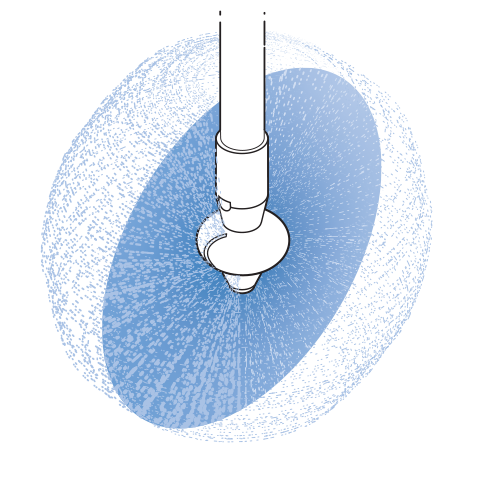
The YS Series spiral (Twister) nozzles are the premier choice for gas washing applications in the process industries. Their unique spiral design has no internal vanes, cores, or small passages — the liquid flows through a single open channel that wraps around the nozzle body, emerging as a full cone spray. This means the YS Series is virtually immune to clogging, even when the scrubbing liquid contains dissolved solids or suspended particles (as is common in recirculated scrubber systems). The spiral design also produces a range of droplet sizes that is well suited to gas washing: enough fine droplets for efficient gas-liquid contact, and enough larger droplets to penetrate deep into the gas stream and wet the tower packing or vessel walls.
For applications requiring extremely uniform coverage in packed towers, the S Series full cone nozzles provide a symmetrical, even spray pattern. The CCS Series (compact, corrosion-resistant full cone) nozzles are designed specifically for scrubber applications where space is limited and chemical resistance is essential.
Downstream of a wet scrubber, the cleaned gas still carries entrained liquid droplets — fine mist that must be removed before the gas is vented or sent to further processing. If this mist is not eliminated, it can cause corrosion in downstream equipment, contaminate products, or carry pollutants past the scrubbing system. While mist eliminators are primarily passive devices (mesh pads, vane-type separators), spray nozzles play a supporting role by washing the mist eliminator surfaces to prevent buildup of captured solids that would block gas flow.
Why it matters: a mist eliminator that isn't kept clean doesn't fail quietly — solids build up on the pad, gas flow gets blocked, and pollutants the scrubber just captured can end up carried right past it.
The F Series flat fan nozzles arranged to spray across the face of mist eliminator pads provide the wash-down coverage needed to keep the pads clean. For hard-to-reach areas within scrubber vessels, the ZF Series quick-connect flat fan nozzles simplify installation and maintenance access.
Petroleum refineries and chemical plants store vast quantities of flammable and hazardous liquids in large tank farms. When ambient temperatures rise — or when a fire occurs in an adjacent tank — the temperature of the stored product can increase to dangerous levels, raising vapor pressure and the risk of overpressure, boilover, or explosion. Water spray cooling systems use arrays of nozzles to apply a continuous film of cooling water over the tank shell and roof, maintaining the steel temperature below critical thresholds.
Why it matters: this spray is what keeps a heat-stressed tank from reaching boilover or explosion territory — it's an emergency control system as much as a cooling one, with essentially no room for gaps in coverage.
The S Series full cone nozzles provide the broad, uniform wetting pattern needed to cover large tank surfaces. For tank roof cooling where the nozzles are mounted at the rim and must throw water across the roof surface, the F and FL Series flat fan nozzles in wide spray angles (80°–110°) are effective. Material selection is typically 316 stainless steel to resist the marine and chemical atmospheres common in tank farm environments.
Fire protection is a regulatory mandate in every chemical plant, refinery, and petrochemical facility. Deluge systems use large numbers of open nozzles that simultaneously flood an area with water when activated by a fire detection system. Water curtain systems create a wall of water spray between a fire hazard and adjacent equipment or structures, absorbing radiant heat and preventing fire spread.
These applications require nozzles that will function flawlessly after potentially years of standby service — reliability is paramount, because the nozzle will be called upon to operate only in an emergency, and failure is not an option.
Why it matters: these nozzles sit unused for years and then have to work perfectly the one time it counts — reliability after years of standby is the entire spec, not a nice-to-have.
The YS Series full cone nozzles in 316 stainless steel are the standard for deluge fire protection systems, providing the thorough area coverage needed to wet all surfaces within the protected zone. For water curtain applications, the F Series flat fan nozzles create the planar spray wall that intercepts radiant heat. The H Series hollow cone nozzles are used where fine droplets are needed for atmospheric cooling and flame suppression rather than surface wetting.
In some petrochemical processes, slurries (mixtures of solid particles suspended in liquid) must be transported through channels or troughs. Spray nozzles creating water curtains can be used to flush slurry through these channels and prevent settling and buildup.
Why it matters: a curtain that can't keep slurry moving lets solids settle and build up in the channel — at that point the flushing system has become the blockage it was meant to prevent.
Chemical plants producing or handling acids, bases, or odorous compounds use spray systems to neutralize spills and scrub odors from ventilation air. Neutralization sprays apply an appropriate chemical reagent (e.g., caustic soda to neutralize acid spills, or an oxidizing solution to destroy odorous sulfur compounds) as a fine mist over the affected area or into the air handling system.
Why it matters: this spray is the neutralization reaction itself, not just a delivery step — undersized coverage or the wrong droplet size means acid or odor compounds go untreated, not just less treated.


The S Series full cone nozzles provide broad coverage for area spray neutralization. For air handling duct applications where fine atomization improves chemical contact with odorous gas molecules, the JPL Series air atomizing nozzles produce the very fine droplets needed for effective gas-phase neutralization and deodorization.
Chemical and pharmaceutical processes that generate fine powders — grinding, milling, blending, tableting — often use wet dust collectors (wet scrubbers) to capture airborne particles. In these systems, spray nozzles inject water into the dust-laden air stream, wetting the particles so they agglomerate and can be collected.
Why it matters: particles too fine to settle on their own need a droplet close to their own size to agglomerate with — get the droplet size wrong and the finest, most harmful dust is exactly what escapes collection.
Chemical, petroleum, and pharmaceutical plants all require periodic cleaning of storage tanks, reactors, and process vessels. Residues, sludge, crystallized product, and biofilm must be removed for product changeovers, inspections, and maintenance. Manual tank entry for cleaning is dangerous, time-consuming, and increasingly restricted by safety regulations — automated tank cleaning nozzles dramatically reduce or eliminate the need for confined space entry.
Why it matters: every cycle an automated nozzle handles cleanly is a confined-space entry someone doesn't have to make — this is as much a worker-safety application as a cleaning one.
The BEX TWK Series tank washing nozzles are purpose-built for this application. Available in machined stainless steel and all-PTFE (Teflon) construction, they produce a controlled spray pattern that systematically washes the entire interior surface of a tank or vessel. The all-PTFE models are particularly important in pharmaceutical and chemical applications where metallic contamination is unacceptable. For larger vessels, BEX rotary tank cleaning heads provide high-impact, rotating solid-stream jets that can remove hardened deposits and thoroughly clean large tanks with minimal water consumption compared to static spray balls.
Many chemical and petroleum processes generate foam — in aeration basins, in agitated reactors, and in separation equipment. Excessive foam can cause spillovers, interfere with level instruments, reduce process efficiency, and create safety hazards. Spray nozzles are used to apply anti-foam chemicals or to mechanically break foam by impacting it with water spray.
Why it matters: uncontrolled foam doesn't just look messy — it can spill over, fool level instruments into misreading the vessel, and create a safety hazard, so knockdown spray is instrumentation protection as much as housekeeping.
For mechanical foam knockdown, the F Series flat fan nozzles and S Series full cone nozzles directed at the foam surface provide the impact needed to collapse foam cells. For anti-foam chemical application, the JPL Series air atomizing nozzles deliver a fine, even mist of anti-foam agent — maximizing effectiveness while minimizing chemical consumption.
Pharmaceutical plants share many of the spray applications found in chemical facilities but add stringent cleanliness, sterility, and documentation requirements.
Pharmaceutical vessels must be cleaned to validated standards between production batches to prevent cross-contamination. Clean-in-place (CIP) systems use spray nozzles inside the vessel to deliver cleaning solutions (caustic wash, acid rinse, purified water rinse) in a repeatable, validated sequence.
Why it matters: a CIP cycle that isn't repeatable isn't just inconsistent — it's not validatable, and an unvalidated cleaning process is a GMP compliance failure before a single batch is ever contaminated.
The TWK Series tank washing nozzles in all-PTFE construction provide the sanitary, non-contaminating cleaning coverage needed for pharmaceutical CIP applications. Their fixed spray pattern ensures repeatable, validatable cleaning performance — a critical requirement for pharmaceutical GMP (Good Manufacturing Practice) compliance.
Pharmaceutical tablet coating — applying a thin polymer film to tablets for controlled release, taste masking, or cosmetic purposes — relies on spray nozzles to atomize the coating solution and deposit it evenly onto tablets tumbling in a coating pan.
Why it matters: the coating window sits between two failure modes — too much spray and tablets stick together, too little and the coating comes out rough and uneven — so droplet control here is the whole process.
The JPL Series air atomizing nozzles are the preferred choice for tablet coating. Their independent air and liquid controls allow precise adjustment of droplet size and spray rate — essential for achieving uniform coating thickness without over-wetting tablets (which causes them to stick together) or under-wetting (which produces rough, uneven coatings).
Chemical, petroleum, and pharmaceutical applications present the most diverse range of corrosive environments encountered in any industry. BEX offers materials matched to virtually any chemical exposure:
| Material | Best for |
|---|---|
| 316 Stainless Steel | Suitable for most aqueous solutions, mild acids, and petroleum-based liquids. The standard industrial choice. |
| Hastelloy C-276 | The go-to material for severe service involving hydrochloric acid, sulfuric acid, chloride-containing solutions, and mixed acid environments. |
| PVDF (Polyvinylidene Fluoride) | Excellent chemical resistance to most acids and organic solvents — with dilute acid solutions, service temperatures can reach 200°F (93°C) or higher depending on concentration. Not recommended for caustic (alkaline) wash applications, where 316 stainless steel or Hastelloy C-276 should be specified instead. |
| PVC (Polyvinyl Chloride) | Cost-effective for moderate-temperature acid and base applications. |
| PTFE (Teflon) | Required in pharmaceutical applications and anywhere that absolute chemical inertness and non-contamination are required. |
The chemical, petroleum, and pharmaceutical industries depend on spray nozzles for safety-critical, environmentally mandated, and quality-essential applications — from the gas scrubbers that keep emissions within regulatory limits, to the deluge systems that protect against catastrophic fire, to the sterile tank cleaning nozzles that maintain pharmaceutical purity. In these industries, a spray nozzle is never just a commodity fitting — it is an engineered component that must be precisely matched to the process requirements.
BEX Engineering provides the full spectrum of spray nozzle solutions for the process industries, with materials and configurations to handle virtually any chemical environment. Contact BEX Engineering to discuss your chemical, petroleum, or pharmaceutical spray nozzle requirements.